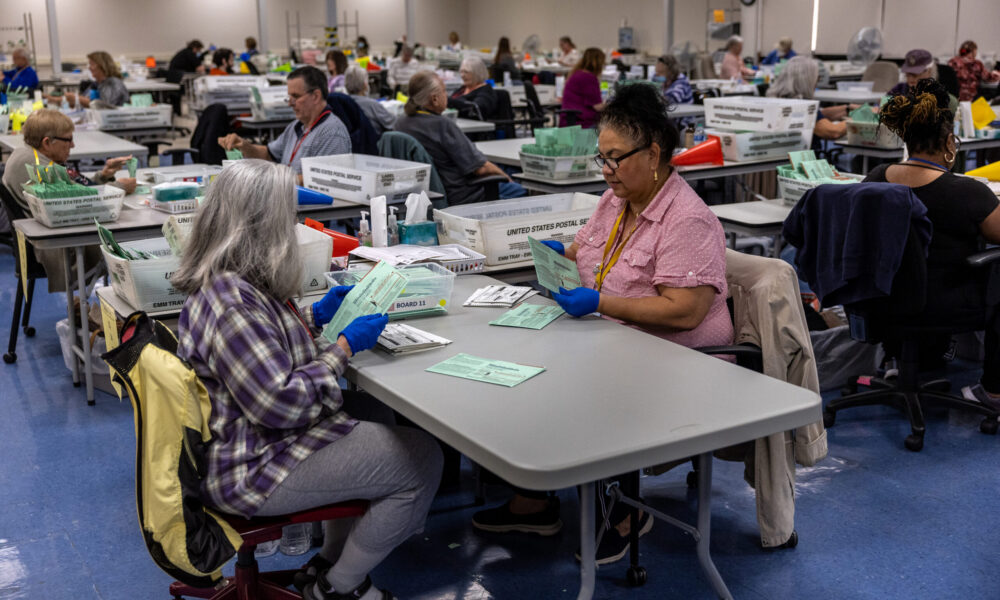

At UCS, we believe that increasing election data transparency is crucial to the study of elections and, more importantly, improving elections for every voter. However, the Trump administration is weaponizing the idea of election data transparency for its own authoritarian means: using it to target political opponents, creating federal lists of “eligible” voters to unconstitutionally supersede state voter rolls, and launching sham investigations of false claims of election fraud based on mis- and disinformation. Good election data practices support democracy, but the Trump administration’s efforts to control elections undermine it.
The battle over election materials and election administration
President Trump is using the Department of Justice (DOJ) and the Federal Bureau of Investigation (FBI) to investigate past elections based on debunked election fraud claims. So far, the FBI has seized 2020 ballots from Fulton County, Georgia, and dispatched over 200 analysts to the state to investigate the 2020 election; the FBI has also seized images of ballots from Maricopa County, Arizona; and the DOJ is currently seeking 2024 ballots and other election materials from Wayne County, Michigan. In Georgia, the federal government has also demanded the names, addresses, and other personal information of election administrators, poll workers, and volunteers.
This isn’t just about relitigating past elections, as bad as that would be on its own. These actions are also meant to intimidate voters and election officials, cast doubt on elections in general, and set the stage for challenges to future elections where President Trump and his allies lose. The more people that doubt the legitimacy of elections, the easier it is to for President Trump and his allies across the country to interfere with them. These fabricated claims are being used to justify passing disenfranchising election laws. At least nine states have passed fifteen restrictive voting laws this year. Of these fifteen laws, nine are set to be in effect for the midterm elections.
In Colorado and Missouri, Trump administration allies requested access to voting equipment, requests that were refused by officials in both states. In Colorado, a consultant who identified themselves as working with the White House contacted 10 Republican county clerks in the summer of 2025 to request to inspect voting equipment. In Missouri, also in the summer of 2025, a DOJ official requested equipment used in majority-Republican counties in the 2020 election. Importantly, the DOJ possesses no legal or constitutional authority over voting equipment and, as former DOJ attorney and current head of the Center for Election Innovation and Research David Becker argues, lacks the required expertise to properly review the machines.
Some states are preparing for the possibility that the federal government or local government law enforcement could try to seize ballots or other election materials. California just passed a law prohibiting the unlawful seizure of ballots, voter rolls, or other materials after Riverside County Sheriff and Republican gubernatorial candidate Chad Bianco seized more than 650,000 ballots from the 2025 redistricting referendum.
And not only is the Trump administration targeting election materials—it is also going after the hard-working administrators who run elections. President Trump and his allies have long unfairly targeted election officials and administrators, including their recent attempts to acquire the personal information of election workers who administered the 2020 Fulton County, Georgia election. This effort was blocked by a federal judge who described it as “unreasonable.” The DOJ also letters to top election officials in every state threatening criminal prosecution over noncitizen voting. Just last week, President Trump fired all members of the Election Assistance Commission (EAC), a body that is supposed to help states administer elections fairly and consistently.
The administration’s quest to grab voter data
In March, President Trump signed an Executive Order instructing the Department of Homeland Security to collaborate with the Social Security Administration to create lists of eligible voters in each state—“State Citizenship Lists.” The Constitution is clear that states and Congress, not the executive branch, have jurisdiction over elections—but this executive order poses considerable risks beyond the constitutional overreach.
The Department of Justice has sued 30 states and the District of Columbia after they refused to share voter registration data. Eight federal courts have dismissed these lawsuits on merit (and one was dismissed for being filed in the wrong venue). At least 15 states have either provided these data or said they would provide full registration lists, which include personal information like Social Security numbers and driver license numbers. The agreement the DOJ demanded of states sharing these data reveals the insufficient security measures the federal government has taken to secure these sensitive, personal data. Alaska and Texas signed this agreement, while Mississippi, South Dakota, and Tennessee refused to sign despite providing the data.
The DOJ has also been shifty about its plans for sharing voter roll data, but the Acting Chief of the Voting Section of the Civil Rights Division said they planned to compare it to the DHS’s Systematic Alien Verification for Entitlements (or SAVE database). Voting rights groups have argued that a national voter list would likely “lead to eligible voters having their registrations revoked and prevented from casting ballots.” The DHS told ProPublica that SAVE identified over 21,000 potential noncitizens but that list had “vast inaccuracies.” Non-citizen voting is already illegal, and the myth that it is widespread has been thoroughly debunked by federal and state-level Republican-led investigations. Despite the lack of any supporting evidence evidence, ICE agents were granted access to voter files in two counties in Texas and North Carolina.
While the EO is the subject of numerous lawsuits, a federal judge decided not to block it, claiming that, since it has not yet been implemented, the parties could not show they had been harmed by the policy (a court decision that is being appealed). Subsequently, the Postal Service has announced a new proposed rule wherein they would only deliver ballots to voters who are on the federal government’s dubious State Citizenship lists. However, a federal appeals panel has agreed to fast-track its review of a lawsuit against this order and should issue a ruling sometime this month. In late June, a federal judge in Massachusetts prevented federal agencies from implementing the EO, effectively blocking the Trump administration from creating a national voter list and the USPS from only delivering ballots to those on said list, stating that the order exceeded the president’s authority, violated separation of powers, and encroached on states’ power to administer elections.
An opening to abuses of power
As Kathy Broockvar (former Pennsylvania Secretary of State and member of our Election Science Task Force) and John Lindback write, at the heart of the Trump administration’s demands for state voter data is a dispute over who controls elections. Their actions raise concerns about data privacy and how these data can be used to disenfranchise voters: “…The Trump administration has offered no clear explanation of how it intends to use the data, who will have access to it, or what safeguards will protect it from misuse or breach,” they note.
It should also be said that these efforts are part of a larger authoritarian strategy to overturn past legitimate elections and further spread disproved allegations of election fraud. The lie that the 2020 presidential election was stolen—a lie that has resulted in violence, distrust, and anti-voting rights legislation and statutes—has been proven false time and time again. Still, President Trump and his allies refuse to admit he lost the 2020 election, continue to push conspiracy theories, and try to make the public doubt the legitimacy of past and future elections for their own political gain. For example, Vernon Jones, a failed candidate for the Republican nomination for Georgia Secretary of State, said that he would publicly release voters’ personal information to support the effort to overturn the 2020 presidential election. Retroactively challenging the legitimacy of elections because you don’t like the result is an attack on democracy and a violation of the rights of voters who participated in those elections.
True transparency supports democracy
Elections should be transparent. But federal and local efforts to seize election materials aren’t about transparency, they’re about controlling the process and sowing doubt, and they could yield disastrous results. Voters could lose the secrecy of their ballots, a critical component of American democracy. The government should not be able to determine who voted for what candidate. Furthermore, if the government has access to ballots or ballot images, there is the possibility that that information could become public.
Election data transparency should be done responsibly and with the intent to improve elections, not interfere with the critical work of election officials, administrators, and workers. Done right, improved election data transparency can improve trust, not undermine it. Improved election data transparency can allow experts to examine where democracy can be strengthened and voting can be more secure and accessible. Done right, improved election data transparency can protect the voting rights of historically marginalized communities, rather than the Trump administration’s efforts to curtail them. Read our full report and see our election science recommendations designed to improve data transparency here.