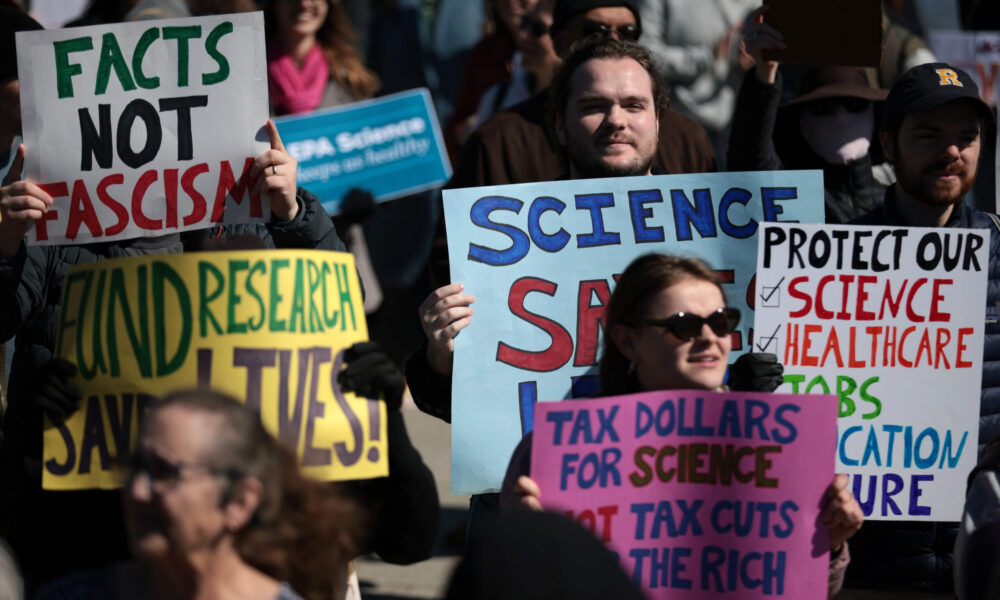

On May 29, 2026, the White House’s Office of Management and Budget (OMB) proposed a revision to the Regulation for Federal Financial Assistance (“the OMB rule”) that would put much of science in the United States under the thumb of the Trump administration. How? By giving political appointees unprecedented power over how the federal government distributes billions of dollars of funding for federal research. If finalized, this rule would turn scientific grant-making upside down, pushing peer review to the side and making every funding decision premised on whether it accords with the White House’s political priorities. It would reward political loyalty over merit and threaten the independence of federal science as we know it.
The OMB rule would also:
- Deny grants that don’t align with the administration’s beliefs
- Allow grants to be terminated if the results are politically inconvenient
- Erect barriers to international scientific collaboration
- Base funding decisions on applicants’ history and organizational “affiliations”
- Require pre-approval for scientific conferences, society memberships and publications
As my colleague Alexa Dietrich, research director for Center for Science and Democracy writes, the OMB rule would “upend US science as we know it.” Political appointees without specific expertise or experience would be the loudest voice on who receives funding for vaccine development, water quality investigations, estimates of disparate impacts from air pollution, or advancing the state of the science on healthcare for LGBTQ+ people. The bureaucratic requirements in this rule would be a restrictive vice grip applied to the scientific community and institutions. What’s more, the proposed rule does not only apply to research funding—the same approach would impact all of the federal government’s discretionary funding, including funding for natural disaster relief programs.
We took a stand
The Union of Concerned Scientists strongly opposes these restrictions on and politicization of federal funding for research, and we laid out our opposition to this harmful rule in a public comment letter.
This policy, we contend, threatens scientific discovery and the scientific research system as a whole, beyond the federal government. Through a variety of agencies and programs, the U.S. distributes billions of dollars every year—and those funding decisions have broad power to shape the direction of science across the country and the world.
- Under this rule, today’s peer review panels—who have specific expertise, specific rules for declaring conflicts of interest, and a mission to advance the cause of science –would be sidelined, reduced to an advisory role for decisions made by political appointees whose primary incentive is to support an administration’s policies. The rule also requires restrictions on funding based on ideological standards that are simply not grounded in scientific evidence. While the administration has announced its intention to evaluate funding based on an insistence on a fundamentally binary concept of gender, we detail how this restriction denies the actual scientific evidence. The administration has also made it clear that they intend to disallow science that studies questions related to diversity, equity, and inclusion—but, as we point out, these limitations —would ignore clear facts and “degrade evidence-based policy in the United States, to the detriment of all Americans.”
- The proposed rule is even inconsistent with its purported objectives of transparency and efficiency, as it requires many unobjective limitations and hurdles and creates uncertainty for the scientific community because of vague, subjective benchmarks. The administration’s deceptively-titled “Gold Standard Science” guidelines give political appointees an open-ended power to disallow research based on flimsy pretexts. The proposed rule isn’t just bad policy—it would also violate the constitutional separation of powers, by shifting spending and policymaking powers from the Legislative Branch to the Executive Branch. In other words, the proposed rule intrudes on Congress’s power of the purse. An administration is supposed to implement the law—not make it.
- Finally, the proposed rule would violate the First Amendment by impermissibly conditioning funding on alignment with the President’s viewpoints, which would create a chilling effect within the scientific community. Good science is driven by curiosity and a drive to understand the real world—not by fealty to a political leader’s whims.
In sum, we and our partners agree: “the proposed rule would violate the Administrative Procedure Act because it infringes on constitutional rights, exceeds OMB’s statutory authority, and is substantively arbitrary and capricious.”
The scientific community spoke up
After OMB published this rule, they posted it the Federal Register and allowed 45 days for the American public to comment. At UCS, we’ve been mobilizing our supporters to fight back, including and disseminating a public comment guide to help people advocate against this proposed rule.
We are not alone in our concern for how the proposed OMB rule upends science.
By the end of the public comment period, the rule had received nearly half a million public comments (public docket, OMB-2026-0034), a huge number and almost entirely in opposition to the proposal. The AAAS and many scientific and research societies from the fields of physics, chemistry, biology, and aerospace have posted their comments, comment guides, or blogs about their specific opposition to the rule. There are comments from associations for cancer researchers, people who study pharmacology, and from social scientists to mathematicians and astronomers. We found posted comments and articles stating concern from historians to people who study marine mammals. And we are seeing concern and engagement from providers and scientists that study and care for the health of wildlife. And we’re hearing from experts who study human health, including the eyes, hearts, brains, and lungs. It’s a flood of public comments showing “overwhelming and lopsided” opposition to this proposal from tens of thousands of individuals who understand science best. Looking through these comments from a diverse group of scientific organizations and associations reminds me why I studied science and continue to ask questions and publish results. Science is about discovery, and it is more about learning than knowing. If we lose the ability to test hypotheses that may not align with a political agenda, or if we lose an ability to present results regardless of how politically inconvenient they might be, we close our eyes to the real world and poison our capacity to solve today’s problems as well as the problems of the future. If this rule were enacted, the administration could deny research grant applications related to life-saving issues like vaccine safety, climate science, and LGBTQ+ health, which have all been under attack by President Trump and his enablers.
Keep advocating for independent science
Many in the US Congress are also questioning and pushing back on the OMB rule, not least because it would represent yet more centralization of power in the hands of the President. That power grab violates the democratic principles of our Constitution. Just as science should be driven by a variety of perspectives, voices, and areas of expertise, government decision-making needs to be democratic, participatory, and accountable to the people.
A lot of people have engaged and pushed back on the OMB rule, but we have to continue standing up to this administration’s many attacks on science. We need to prevent further damage, but we also need long-term solutions.
That’s why we at UCS support the Scientific Integrity Act. This bill was recently re-introduced in the US Senate. It would establish stronger safeguards to protect federal scientists from political interference, require agencies to maintain scientific integrity policies, and ensure government decisions are informed by evidence rather than political agendas.
At a moment when independent science is under immense and increasing pressure, Congress must move swiftly to advance the Scientific Integrity Act and strengthen all available guardrails. This piece of legislation gives watchdogs, courts, and the public the tools to fight back against politicization of federal science. Please show your support for the Scientific Integrity Act. You can use this link to contact your Representatives in the House, and this link to contact your Senators.