

Science is being threatened at a pace and scale we’ve never seen before in the federal government. It’s nearly overwhelming—but we’ve built a new system to help us monitor and explain what’s happening, looking both incident by incident and at the larger pattern.
Last week, the Union of Concerned Scientists (UCS) released a new, interactive tool that shows the number of attacks on science and potential scientific integrity violations committed by the second Trump administration. UCS has documented a shocking 576 attacks and 188 potential scientific integrity violations between January 20, 2025 and June 29, 2026.
The Attacks on Science Tracker is a transparent, fully accessible analytical platform backed by a rigorous methodology. It acts as a public record of elected officials politicizing federal science, from the start of the second Trump administration into perpetuity. And it vividly illustrates not just how elected and political officials attack federal science, but how it affects all of us—undermining the science, including climate science and medical information, that we need to stay safe and healthy. It also shows how many of these attacks could be prevented by passing the Scientific Integrity Act.
Introducing the Attacks on Science Tracker
The UCS Attacks on Science Tracker is the culmination of an effort I’ve led over the past several months (with the help from an entire village worth of people!) to evolve the Center for Science and Democracy’s methodology to track attacks on science. We undertook this effort in response to the second Trump administration’s ferocious and systemic attack on federal scientific systems and on our democracy.
The Center has been tracking attacks on science and advocating for scientific integrity protections since 2001, and this work continues more than two decades later through research, community organizing and outreach, and policy advocacy. The Tracker and its methodology were created to support all these avenues of work within and outside of UCS.
This means that anyone who cares about science can take advantage of the tool’s interactive features, robust data, and transparent methodology to hold elected officials accountable, document harms from the past into the future, and advocate for evidence-informed policy and scientific integrity protections. These are all necessary for a healthy and functioning democracy, one that exists to protect all its people.
We need the Scientific Integrity Act
Scientific integrity protections, in particular, are critical, because they help keep science independent from political, corporate, and financial influence. These policies help federal scientists conduct and communicate their scientific work about toxic chemicals, vaccine safety, climate change, and other topics free from the threat of alteration, suppression, or censorship. With independent science, all of us—the public and decisionmakers—can hear the full story, and can make both policy and personal decisions based on the best available science.
A major feature of the new Attacks on Science Tracker and its methodology is that it identifies which of the documented attacks constitute potential scientific integrity violations. Anybody can use this data and interactive visualizations to advocate for scientific integrity protections and the passing of the Scientific Integrity Act.
Not every attack on science is a scientific integrity violation, but these concepts are inherently linked. Think of “attacks on science” as a broader umbrella term that encompasses all the various ways that elected and political officials politicize science.
In the recently released Attacks on Science Tracker, we categorize attacks on science into 11 differenttypes of attacks to contextualize how officials politically interfere with science.
Passing and enforcing the Scientific Integrity Act would have helped to prevent about a third of the total number of attacks on science we’ve documented since January 20, 2025. That’s almost 190 instances of political interference that have implicated climate science, equity, the environment, and health and safety.
How we categorize attacks
In our data, potential scientific integrity violations are specific types of attacks on science. We chose these types of attacks on science based on the most current text of the Scientific Integrity Act. The bill doesn’t explicitly define scientific integrity violations, but does list several examples of the types of political interference (like censorship) the bill would help prevent.
We use the bill text as a metric for which attack types to classify as potential scientific integrity violations. However, there may be potential discrepancies between our attack type definitions and what is considered a scientific integrity violation based on current bill text. Thus, our potential scientific integrity violation data should be used for informational purposes, not treated as the final determination of the presence of a scientific integrity violation.
Based on the most current bill text, we classify the following five (out of 11) of our attack on science types as potential scientific integrity violations. We’ve seen the Trump administration commit many examples of each since inauguration, and these attacks come at the expense of all of us, by undermining the science and science-based policies we depend on.
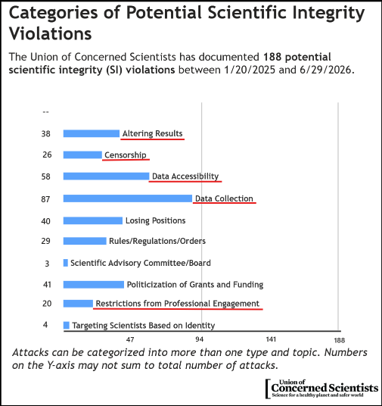
Note: Red lines added to denote attack types classified as potential scientific integrity violations.
Altering Study Results: This variable captures when elected or political officials edit, misrepresent, or manipulate a federal (or federally funded) scientific study. Between January 20, 2025 and June 29, 2026, the Attacks on Science Tracker has documented 38 of these types of potential scientific integrity violations. As an example, the Trump administration altered over 100 federal datasets related to public health and safety to align with its anti-science and anti-trans executive orders. In another incident, a political official in the Office of the Director of National Intelligence urged analysts to redo an analysis because its results conflicted with the White House’s policy priorities.
Changing the results of a study or the data that informs them is blatant politicization and could ultimately call the reliability and accuracy of the study into question. Trusting this information and making informed personal and policy decisions becomes much harder to do in the short term. In the long term, this can change the scientific record on many different topics and sideline the ability for future researchers to assess the best-available science when conducting new studies.
Censorship: This represents when elected or political officials stop or control federal scientists’ public communication. There are 26 censorship attacks recorded in the Attacks on Science Tracker, encompassing various instances when federal agencies and officials have instituted additional political review of projects before they’re published in peer-reviewed journals, stymied communication and materials related to the administration’s prohibited topics, and halted all external health agency communication shortly after President Trump’s second inauguration.
When their communications and messaging are restricted or halted, federal scientists may not be able to relay accurate and important scientific information, either in a timely manner or at all. This interference is especially concerning when the restricted information is about public health, like emerging infectious diseases or cancer treatments and diagnoses.
Data Accessibility: This variable captures when elected or political officials eliminate federal data or scientifically informed information or make it less accessible to the public. We documented 58 data accessibility attacks in the Tracker as of June 29, 2026. The administration’s efforts to scrub federal websites and scientific guidance that includes any mention of transgender, non-binary, and intersex people is a prime example of this type of attack. But there have been several others that have unfolded since, including when the Environmental Protection Agency removed materials from their website that drew connections between human actions and climate change.
Removing taxpayer-funded scientific information from federal websites like this alters the critical information researchers, decision-makers, and entire communities need. And suppressing the availability of information that goes against the administration’s priorities can sow doubt in established scientific facts.
Data Collection: This encompasses instances where elected or political officials interfere with or stop the data collection of a scientific study. There are 87 such attacks in the Attacks on Science Tracker, including an incident where the Trump administration, using explicit political language, canceled ongoing research that would help determine the safety of pipelines that transport hazardous materials to the environment and nearby communities. In another incident, the administration canceled an annual survey that helped assess the state of food insecurity in the US, claiming it had become “politicized”.
Looking at this type of attack, I often think of the popular adage: “only what gets measured gets managed.” Halting data collection makes it difficult for the government to assess the true scope of any given topic and provide the necessary resources and support in response. Refusing to see a problem can be an excuse for simply declining to address it at all. And in the case of canceling ongoing studies—or studies that have already used federal resources and compiled data—it’s simply wasteful.
Restrictions from Professional Engagement: This refers to incidents where elected or political officials cancel federally sponsored research events, bar federal scientists from attending such events, or investigate scientists for their involvement in such events. 20 of these types of attacks are documented in the Attacks on Science Tracker. As soon as the first week after President Trump returned to office in January 2025, all travel and grant review panels were paused indefinitely in federal health agencies and at the National Science Foundation. And during a time of increased bird flu infections and uncertainty of how it could spread, the Centers for Disease Control and Prevention ordered the National Academy of Sciences to cancel a workshop that was meant to provide guidance to medical professionals and farmers on best practices for protecting themselves against infection.
This type of attack has far-reaching and, perhaps, less visible consequences. Pausing grant review panels indefinitely halted the ability for federal agencies to review and disseminate federal research grant applications, throwing people’s projects, jobs, and entire careers into jeopardy. And preventing federal involvement in conferences and workshops can prevent collaboration among resources or undermine the timely dissemination of critical information needed to help communities navigate natural disasters and keep people safe from emerging diseases.
We’re not just watching—we’re pushing back
The Attacks on Science Tracker provides unique and robust documentation of political interference in federal science and presents many opportunities for people to advocate for evidence-informed policies and scientific integrity protections. This is the type of advocacy that recently brought the Scientific Integrity Act back to the Senate for the first time in seven years. You can help us keep the momentum going by:
- Getting acquainted with the Attacks on Science Tracker and its many interactive features. UCS is hosting a webinar tomorrow, on July 1 (4-5p ET), in support of efforts to protect federal science. During the webinar, I’ll introduce the audience to the Tracker and walk through some examples of how it can be used to advocate for scientific integrity protections, and my colleagues will provide an update on the Scientific Integrity Act. Join us!
- Urge your Congresspeople to co-sponsor the Scientific Integrity Act, which can help prevent the very types of attacks I laid out here. Use this easy link to contact your Representatives in the House, and this link to contact your Senators.
- Spread the word about the Tracker by sharing our posts on Facebook, Instagram, Bluesky, and LinkedIn.
- And stay up to date on UCS’s other advocacy actions by regularly checking our website.