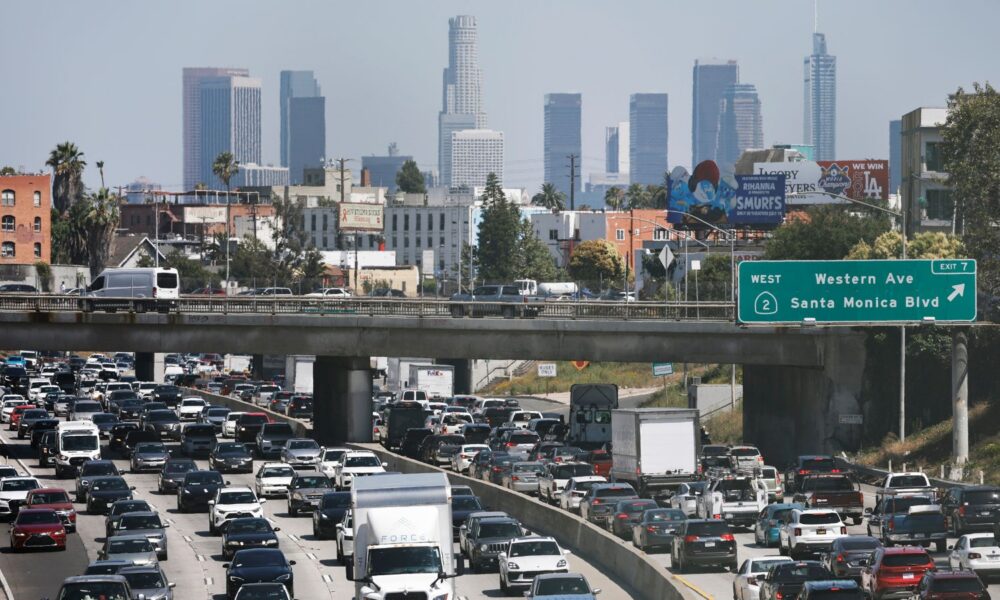

Last year, Congress (with the help of the EPA) used an illegitimate approach to stop California from enforcing future standards to require cleaner cars and trucks. Now the EPA is essentially asking Congress to reach back and invalidate standards that were designed as early as 2004—two decades ago. Why is the EPA attacking clean air standards that predate the iPhone and that have already been fully implemented? Because those older standards could become California’s backstop to prevent automakers from selling dirtier cars and trucks, if the EPA and Congress succeed in wiping out the state’s newest clean car protections.
California has been fighting vehicle pollution for 60 years
California’s first clean car standards were enacted in 1966, as the state took action to deal with pervasive smog and air pollution, especially in the Los Angeles Basin. In recognition of California’s leadership, when the federal Air Quality Act of 1967 was passed (later amended to be the Clean Air Act), it explicitly allowed California to continue to set stricter pollution standards for cars and trucks to address the state’s persistent and deadly poor air quality.
What is a Clean Air Act waiver?
California follows a two-step process to enforce vehicle pollution standards. First, the California Air Resources Board (CARB) carefully researches potential regulatory mechanisms and adopts standards for vehicle manufacturers that want to sell cars in the state. Second, the federal Environmental Protection Agency is directed by the Clean Air Act to issue a waiver of federal preemption to allow California to enforce those standards if they meet the Clean Air Act requirements, such as being at least as protective than the federal standards. Since the 1960s, California has received numerous waivers to enforce standards to protect public health and the environment.
How EPA and Congress attacked California’s clean car standards
Last year, Congress took the unprecedented step of mischaracterizing the waivers for California’s Advanced Clean Cars II, Advanced Clean Trucks, and Heavy-Duty Omnibus standards as “rules” subject to the Congressional Review Act (CRA). Despite the ruling of the nonpartisan Senate Parliamentarian that the waivers are not subject to the CRA because they are indeed not rules, Congress passed CRA resolutions and they were signed by the president. These actions have put the future of clean transportation in California at risk as the state sues to overturn these actions.
Not content with stopping future clean cars, the EPA is now asking Congress to use the same illegitimate mechanism to undo prior waivers, going all the way back to the greenhouse gas emission standards for model year 2009 cars and trucks, standards that have already been fully phased in.
California received a waiver in 2009 for greenhouse gas (GHG) emission standards for cars and trucks (known as the Pavley standards). These standards were largely mirrored by Obama-era federal standards. In addition, CARB received a waiver in 2013 to establish the Advanced Clean Cars (ACC) standards. These standards included smog-forming pollution limits, caps on GHG emissions, and a sales requirement for zero-emission vehicles (ZEVs), all of which steadily grew more stringent through model year 2025, with an electric vehicle sales requirement of about 8 percent of new cars. The auto industry complied with the standards, resulting in new gasoline, hybrid, and electric cars that are cleaner than ever. From 2012 to 2024, global warming emissions from new passenger vehicles dropped over 25 percent. And drivers are also benefiting from thousands of dollars in fuel savings as they switch from less efficient gasoline cars to electric vehicles.
EPA is now attacking the remaining clean car standards
Why is the EPA interested in getting rid of standards for vehicles that were sold over 15 years ago? The answer lies in CARB’s response to last year’s CRA action on clean car waivers. When Congress and the president used the CRA against the waivers, in addition to the legal response, CARB started an emergency regulatory process to clarify that certain prior clean car standards were still valid if the new standards could not be enforced. Specifically, CARB signaled that it would enforce the standards on smog-forming pollution and GHG emissions at the 2025 levels for cars and trucks until new standards are enacted, or a court reinstates the Advanced Clean Cars II standards currently on pause. Notably, CARB is not seeking to enforce the 2025 ZEV sales requirements, so there is no California requirement for electric vehicle sales if the Advanced Clean Cars II standards are not reinstated.
These existing state-level vehicle standards are already being met by automakers. The Trump administration has already rolled back federal greenhouse gas standards for vehicles, and is in the process of rolling back criteria pollution standards for vehicles in a two-part rulemaking. If these deregulatory actions are successful, California could have no protection against automakers reverting to the dirtier cars and trucks from decades ago.
Strong standards needed for clean air and slowing climate change
California’s clean car authority has delivered cleaner air for decades, and weakening it now would mean more pollution, higher emissions, and fewer protections for public health. Erasing standards that automakers are already meeting will only have negative effects, and will significantly set back efforts to clean the air. With these actions, Californians will have to rely on federal vehicle standards, a losing proposition given the strong anti-science stance of current EPA leadership. The EPA has already claimed that global warming pollution shouldn’t be regulated, via the repeal of the Endangerment Finding, and has signaled that health-protecting tailpipe emissions standards will be rolled back.
California has the worst air quality in the nation and has failed to meet the federal standards for several pollutants, including ground level ozone and particulate matter pollution. The state’s plans to achieve compliance with these standards relies on the ability to require cleaner vehicles. Without the authority to regulate pollution from mobile sources, the state will have to significantly revise its plan to comply, and may force more significant emissions reductions from other sources.
Rolling back California’s standards would not just increase pollution; it would also cause significant regulatory uncertainty for an auto industry that has already made investments to develop cleaner cars to meet state and federal standards. The way forward is to maintain the standards that are already working to protect public health and put us on a path to slow climate change. Congress should reject Congressional Review Act resolutions that violate its authority to protect its residents from pollution.