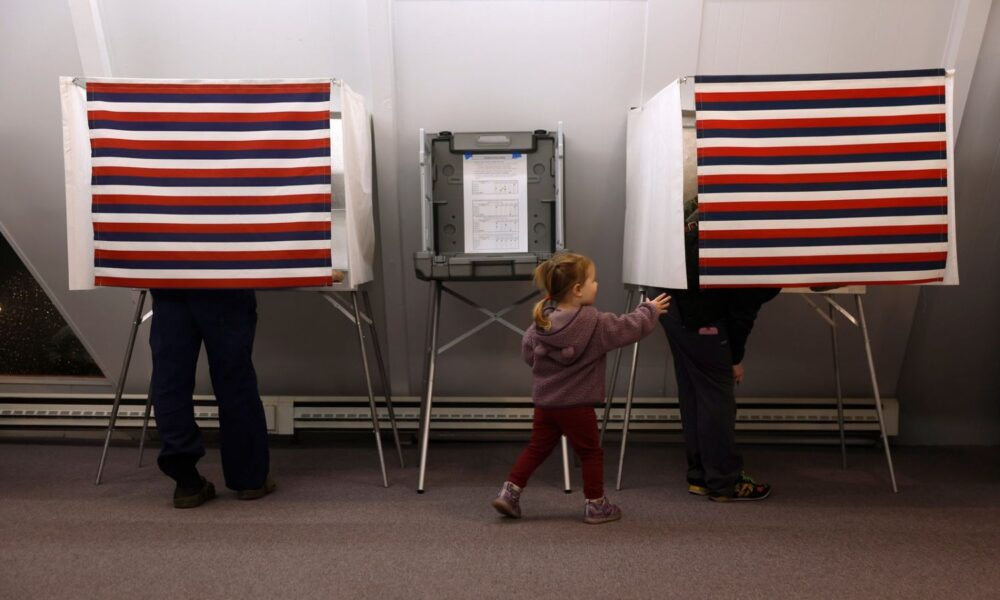

The 2026 midterm elections changed the balance of power in Washington. Voters elected Democratic majorities in both the House and Senate, creating new opportunities for Congress to check executive overreach, investigate attacks on science and public institutions, and advance policies grounded in evidence. The results do not erase the damage of the last two years, and they do not end the threats ahead. But they do show that voters can change the terrain on which the fight for science and democracy takes place.
But before we move too quickly to what comes next, we should celebrate something fundamental: millions of people participated in our democracy. Voters made their voices heard. Election officials, poll workers, volunteers, and public servants across the country once again did the essential work of administering an extraordinarily complex election. Many of them did so after years of political pressure, harassment, and even threats. Safeguarding free and fair elections requires people willing to defend the process itself. That deserves recognition. That is a win for democracy.
The election also broke long-standing barriers to political representation. Voters elected the nation’s first Black woman governor, its first Native American woman governor, and its first Native American women senator, among other historic firsts. These victories matter not only because of who won office, but because a healthy democracy depends on giving everyone the opportunity to exercise political power and ensuring that our institutions better reflect the people they serve.
There are important outcomes to celebrate for science, too. A new generation of scientists, physicians, and public health experts is headed to Congress, bringing firsthand experience with the importance of science and evidence in shaping public policy. Among them are epidemiologist Abdul El-Sayed, elected to the Senate from Michigan; microbiologist Jasmine Clark, who will become the first Black woman with a science PhD to serve in Congress; and pediatrician Richard Pan of California. Returning science champions will also have greater opportunities to defend federal research, strengthen scientific integrity, and hold the administration accountable.
After nearly two years of relentless attacks on science, public institutions, and democracy, those victories matter. We should celebrate them. And then we need to get back to the work we have been doing over the past two years – defending science and the lifesaving policies it underpins. The election changes the terrain, but it does not change the mission: to defend science for a healthy, safe, and just future.
Accountability matters for science
Since President Trump returned to office, the Union of Concerned Scientists’ Center for Science and Democracy has documented 625 attacks on science, including attacks affecting public health, research funding, federal scientists, and potential violations of scientific integrity. Our tracker doesn’t just count attacks; it, creates a public record of incidents that reveals larger patterns across the administration. That record is essential to accountability.
Reliable, accessible data are essential to democratic accountability because they give scientists, watchdogs, journalists, policymakers, and the public the evidence they need to independently assess what government is doing and hold officials accountable. Suppressing data or undermining the institutions that produce it doesn’t just impair science; it weakens one of the mechanisms by which democracies constrain abuses of power. This is not a hypothetical concern. Implementing a key tactic in Project 2025, the Trump administration has altered or wiped hundreds of federal datasets and websites that contradict the administration’s ideology. Project 2025 included at least 92 recommendations to delete or alter government data, censor scientific information, or weaken transparency, many of which the Trump administration has already implemented. This was not simply an effort to eliminate information the administration found inconvenient. It was part of a deliberate strategy to control what the public can know, making it harder to hold government accountable.
A new Congress willing to exercise meaningful oversight can counter that strategy. It can hold hearings, investigate abuses, demand documents, protect whistleblowers, scrutinize appropriations, and ask hard questions of political appointees. It can investigate not only whether science was suppressed or manipulated, but why, by whom, and for whose benefit.
Accountability does not stop at merely counting attacks. We need to understand who was harmed and when government stopped listening to evidence. UCS has been documenting the harms from the Trump administration over the past two years, and we support oversight efforts through original research, supporting witness testimony, and providing a roadmap of questions, including: Which communities lost protections? Who faced heightened environmental or public health risks? Who voices were excluded from public participation? Whose research disappeared? Which communities already shouldering disproportionate environmental and health burdens paid an even greater price when science was ignored?
We should also ask which safeguards worked, which failed, and which turned out to depend far too heavily on norms and the good faith of government officials. Accountability is not about relitigating every outrage of the last two years. It is about understanding what happened, who was harmed, and what we need to change so it cannot happen so easily again.
Protect the institutions that protect us
While Congressional oversight can matter, we must be clear-eyed about what this election does not change. Even if science champions have more power in Congress, it is imperative to recognize the executive branch will likely remain hostile to independent science. Federal agencies still sit within that executive branch. The people dismantling scientific capacity, sidelining experts, and weakening safeguards do not disappear when a new Congress is sworn in.
Nor does the broader authoritarian threat disappear. As I have explained over the past year, authoritarianism rarely arrives all at once. It advances by weakening institutions and democratic norms piece by piece, making it harder for people to participate in public life or hold their leaders accountable. Attacks on scientists who tell inconvenient truths, censorship of government information, politicization of the civil service, voter suppression, and attacks on independent institutions may look like separate incidents, but together, they threaten the democratic infrastructure that allows science and communities to thrive.
When authoritarian-minded leaders lose control over parts of government, the threat does not necessarily recede. Research shows that political setbacks can increase incentives to use repression, legal manipulation, and remaining government authority to constrain opponents or evade accountability. With Democrats poised to control both chambers of Congress and subject the Trump administration to greater scrutiny, there is reason to be especially vigilant. Experts who track democratic backsliding have documented how Trump’s corruption, efforts to evade accountability, and drive to consolidate power reinforce one another. Losing congressional allies may constrain his legislative agenda, but it could also increase his reliance on executive authority, retaliation, and other efforts to circumvent institutional checks. The need continues for stronger institutional checks, including limits on emergency powers, domestic military deployment, spending, war powers, and surveillance. The lame-duck period session could bring upheaval and harmful actions of the Trump administration could continue or intensify. This is not the moment to let our guard down.
It’s not just the biggest headlines that matter. Proposed changes to OMB’s federal financial assistance, for example, could reshape federal research funding and give political appointees greater influence over grant decisions traditionally grounded in scientific peer review. At NOAA, cuts to staff, budgets, datasets, and other scientific resources threaten the forecasts and warnings communities rely on to prepare for dangerous weather. And allowing polluters to seek exemptions from Clean Air Act requirements risks weakening protections meant to keep people safe. These actions may sound narrow, but their consequences are broad. The institutions and rules of government determine whether our drinking water is safe, whether a medicine works, whether our communities get accurate hurricane warnings, and whether dangerous air pollution is regulated using the best available science. Scientific integrity isn’t just about protecting scientists. It protects all of us by helping ensure that government decisions are based on facts and evidence rather than political demands.
Democracy happens between elections
It’s important to remember that participating in democracy means voting and then going home. Democracy does not happen only on Election Day. It happens when communities participate in government decisions, when people have access to government information, and when the census accurately counts our communities. It happens when voters choose their representatives instead of politicians choosing their voters, and when people can translate their votes into actual political power. My colleague Carlos Algara made this point in his recent post on threats to electoral accountability: gerrymandering, voter disenfranchisement, and interference with election certification can all weaken the fundamental democratic mechanism through which voters hold leaders accountable. And my colleague Joe Reed highlighted the long-term impacts of the recent gutting of the Voting Rights Act during the Trump Administration.
And many of these problems run deeper than any single election. The Center for Science and Democracy has used the science of elections to identify evidence-based ways to improve voter access, public trust, election administration, and fair representation. Our Election Science Task Force brought together election scientists, democracy researchers, community organizers, voting-rights attorneys, and elected officials to examine precisely these questions.
Defending the democratic institutions we have is not enough. We should also ask how to build institutions that better translate people’s votes into political power. That includes exploring reforms like proportional representation, which could make our representative institutions more reflective of voters’ preferences and help build a truly multiparty, multiracial democracy. These reforms are not separate from the work of protecting science and evidence-based decisionmaking. When more people have a meaningful voice in choosing their representatives, government is more accountable to the public it serves and to the reality they live in. Defending each individual election is necessary. But we should also be building a democracy that is harder to manipulate in the first place.
What the 120th Congress can do for science and democracy
Two years ago, following the 2024 election, I wrote about the difficult road ahead for science and democracy. The dangers I anticipated materialized, often at a scale that even those of us preparing for them struggled to imagine.
But something else happened too. Scientists spoke up. Science supporters advocated on capitol hill for the Scientific Integrity Act. Communities fought back. Public servants continued doing their jobs. People went to court. They submitted comments on dangerous regulations. They called Congress. They organized. They protested. And this past week, tens of millions of people voted. That matters.
The election has created a pivot point. For the past two years, scientists, communities, public servants, and science supporters have documented attacks, challenged unlawful actions, defended evidence, and kept pressure on Congress. A fundamentally different 120th Congress can build on that record to deliver oversight, legislation, and stronger safeguards. Here is what it can do:
- Congress should enact durable scientific integrity protections. It should advance the Scientific Integrity Act and establish enforceable protections against political interference in federal science, including meaningful processes for scientists to report and remedy violations.
- Congress must investigate attacks on science and public institutions. It should use hearings, subpoenas, appropriations, and other oversight tools to examine political interference in science, the decimation of the federal science workforce, the cancellation of research grants, the manipulation or disappearance of government data, and weakened public-health and climate safeguards. UCS will support this work with the research and analysis collected through its attacks on science tracker and related work.
- Congress must defend public participation and access to information. It should protect public-comment processes, federal data, government websites, and the ability of communities and independent experts to help shape policies that affect their health, safety, and environment.
- Congress should protect evidence-based federal funding. It should challenge harmful changes to OMB’s federal financial assistance rules, and use appropriations and oversight to protect peer review from political interference.
- Congress must protect democracy between elections. It should resist further rollbacks of the Voting Rights Act, safeguard election administration and the census, and advance representative institutions that translate people’s votes and voices into political power.
A new Congress creates real opportunities, but it does not end the fight. The people dismantling scientific capacity and weakening safeguards will not disappear in January. So Congress must use its power, while scientists, advocates, communities, and the courts continue defending the public interest.
Restoring federal science doesn’t mean rebuilding the same system with the same vulnerabilities. The federal science enterprise has produced enormous public value, but it has been unevenly protected, inefficient, and inequitable. This is an opportunity to build a more resilient, responsive, and just science-for-policy system that serves people and strengthens democracy.
Election Day was not the finish line. It was another step in the ongoing work of democracy. And the last two years have reminded us that none of us are powerless in that work. We are the antidote to doomerism. Democracy is something we build together, every day.