
We’re a year and a half into the Trump administration’s destructive attacks on FEMA and climate policies and research, and now Trump’s FEMA Review Council has delivered recommendations that are completely out of step with the nation’s emergency management needs. One would hope that the President’s FEMA Review Council, established to elicit recommendations on the future of FEMA, would advance strategic thinking on longstanding issues outlined recently in the Government Accountability Office (GAO) three-part series on workforce readiness, state and local response capabilities, and assistance for disaster survivors. Such strategic thinking was brought forth by the Biden administration before President Biden left office with the release of the White House National Resilience Strategy. Instead, the report fails to deliver on important FEMA restaffing and policy and program reforms.
Unfortunately, the FEMA Review Council report misses the moment we’re in. We’re facing triple crises: the fossil-fueled impacts of climate change are worsening disasters, which are colliding with the affordable housing shortage and day-to-day affordability challenges people are facing, as well as the harms caused by Trump’s authoritarian government.
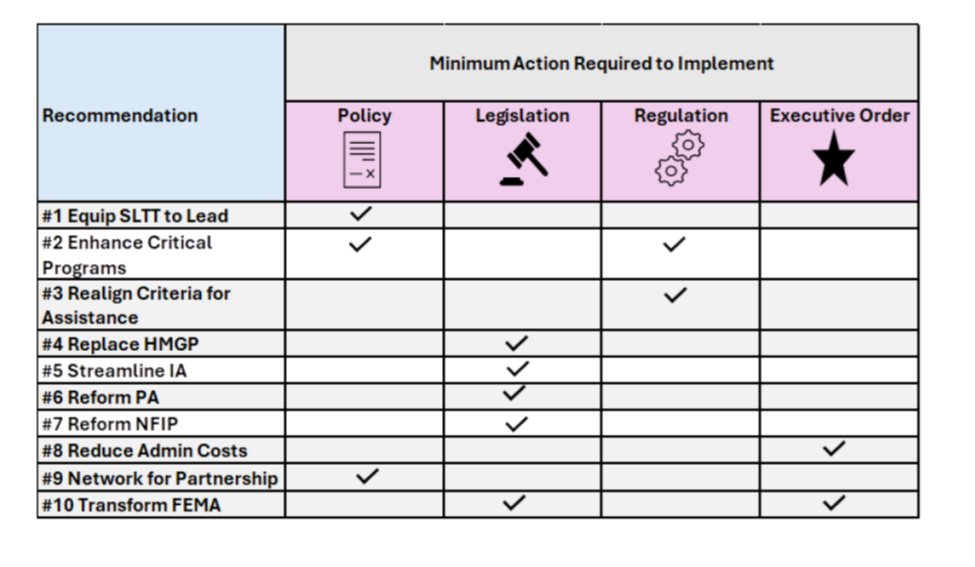
Admittedly, this version of the council’s report is an improvement to the disastrous draft leaked back in December, led by former Department of Homeland Security (DHS) Secretary Kristi Noem. However, if implemented, this report’s recommendations would make drastic changes to disaster aid (both public and individual assistance) leaving communities, especially lower income disaster survivors, with fewer resources to recover. The recommendations also would: push the privatization of federal flood insurance, place more responsibilities—such as trainings—onto state, local, tribal and territorial governments (SLTTs) and “rebalance” FEMA’s workforce, ultimately reducing staff even more. Most of the recommendations in the report would require congressional action to be implemented—and Congress should make sure that never happens!
UCS opposes FEMA Review Council report’s ten recommendations which, if implemented, would continue the Trump administration’s harmful plan to place the extraordinary burden of responding to disasters onto the shoulders of SLTTs while leaving the most vulnerable more exposed to harms from disasters with fewer resources. FEMA was established to coordinate and support SLTTs, not to recreate 56 different response and training entities.
As written, the recommendations have numerous flaws and contradictions and would exacerbate inequities faced by households and communities with fewer resources, including many communities of color and Tribal communities.
I submitted a letter to the council on behalf of UCS, criticizing the council’s omission of critical science-based context like climate change which heightens dangers facing the US. You can read UCS’s full set of comments here, and below is a brief summary.
Climate change risk, administration’s FEMA cuts ignored
The first problem with the report is its failure to acknowledge climate change-related risks and impacts or the need to invest in pre-disaster mitigation and adaptation. This year (as of March 31, 2026), there have been 5 extreme weather and climate disasters that each met or exceeded one billion dollars with a loss of 176 lives and a total economic cost of $12.4 billion. These losses come on the heels of years of record-breaking climate impacts that fossil-fueled climate change had a role in worsening. Climate change:
- Increased the strength of Hurricane Erin (August of 2025) from a category 4 to a category 5 storm, increased windspeed by 10mph, and warmed the water temperature in the path of the hurricane by 1.2°C.
- Increased Hurricane Helene’s (September 2025) windspeed by 10 mph, made the waters over which it passed 1.2°C warmer and made the 20-30 inches of rainfall at least 10% heavier.
- Made the heatwave in mid-July of 2025 at least three times more likely for nearly half of the US population and the extensive mid-March heat wave this year three to five times more likely.
- Increased the Fire Weather Index an estimated 6% for the January 2025 Los Angeles wildfires (Palisades and Eaton wildfires) and made the wildfires 35% more probable.
The council members wrote the final recommendations without regard to these harsh realities or the Trump Administration’s ongoing dismantling of FEMA. The chaos and consequences of the last eighteen months should have informed the final recommendations on the future of FEMA given the implications of the numerous destructive actions by President Trump, former DHS Secretary Noem, and three former Senior Officials Performing the Duties of the Administrator (SOPDA).
These destructive actions have included:
- Reducing FEMA’s workforce by one-third, including a significant loss of senior expertise
- Delaying and politicizing disaster assistance
- Cancelling grant programs (only to have them brought back through litigation)
- Canceling FEMA’s national and technical advisory committees
- Establishing a work environment based on fear and retaliation, and
- Slow-walking or withholding of Congressionally appropriated funds, among others.
Trump’s hand-picked council embraced disinformation
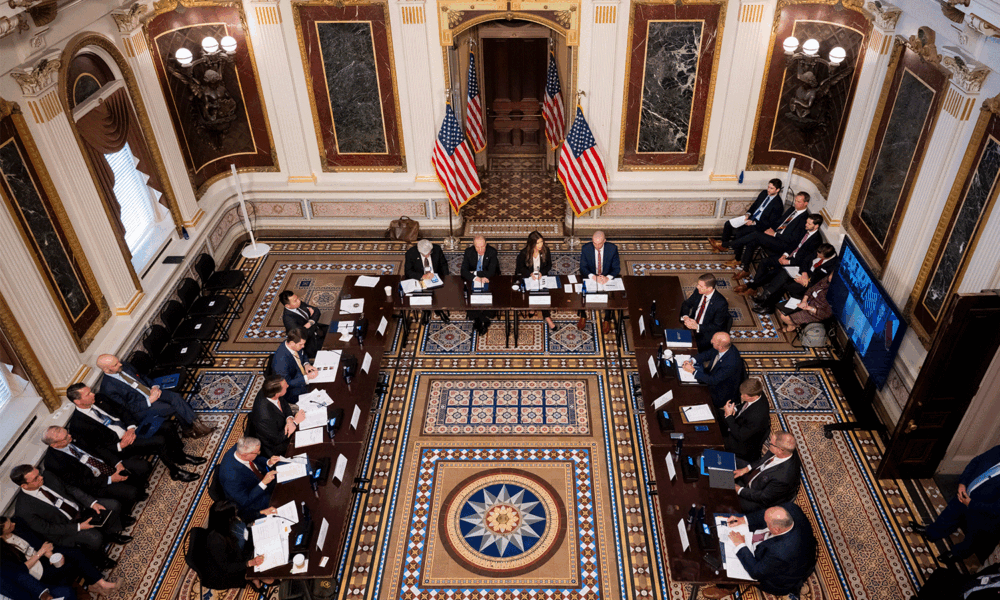
You may recall that President Trump established the 12-member FEMA Review Council in January of last year by executive order to develop this final report. The council held three publicly noticed meetings and had a series of drama filled moments and delays, including the leaked December 11, 2025 draft, last-minute cancellation of a key meeting, and the President’s extension of the council (until ten days after the final report is submitted to the president or May 29, whichever came first).
The council released the final report at their last public meeting on May 7. True to form, the council only opened the Federal Register for public comments just one week prior to the final FEMA Review Council meeting, again allowing insufficient time for meaningful input. There were 148 public comments submitted by the June 8, 2026 deadline.
There were many logistical issues regarding the council that ensured its insular vision and lack of policy specifics including the fact that:
- The small ten-member board (not counting the board chairs DHS Secretary Markwayne Mullin and Department of Defense Secretary Pete Hegseth) lacked diversity;
- It disincentivized meaningful public input by misaligned timelines;
- The council violated the Federal Advisory Committee Act which requires all meetings to be publicly noticed and the proceedings documented; and
- It embraced disinformation in the final report multiple times.
Specifically, the council spoke to how the recommendations and report messaging aligned with its own survey results, but a review of that survey in the report’s addendum demonstrates respondents’ support for a strong FEMA that supports SLTTs, the need to invest in pre-disaster mitigation, and the need for funding to help SLTTs, among others. This is not simply a contradiction between recommendations and survey results, it’s a misrepresentation of the survey results.
FEMA, Congress shouldn’t implement council’s recommendations
The next steps regarding the implementation of the FEMA Review Council report are unclear. As mentioned above, one key thing to recognize is that most of the report recommendations require congressional action.
Many of us who attended the Association of State Floodplain Managers conference think FEMA will try to implement as much as it can under its likely new administrator, Cameron Hamilton (yes, the same person President Trump fired last year, now nominated to lead the agency). During the Senate Homeland Security and Governmental Affairs confirmation hearing, Senators grilled Cameron Hamilton on the politicization of disaster assistance among other issues. Nevertheless, by all estimates he will be confirmed as the first FEMA administrator after President Trump’s 16 months in office and four SOPDA’s or temporary administrators.
It’ll be bad news for the nation and FEMA if Cameron Hamilton moves forward with implementing the parts of the report he thinks he can without Congressional action. It’ll mean:
- Fewer disaster declarations even as the harms of extreme weather and climate-fueled disasters mount;
- Less disaster assistance for disaster survivors with fewer resources and more assistance to wealthier communities;
- More unfunded responsibilities shifted to SLTTs for training, response, and recovery;
- Gutted FEMA workforce; and
- Fewer resources directed to pre-disaster mitigation.
As disaster and emergency management expert Dr. Samantha Montano summarized, sadly the report is a political exercise, gets many things wrong and is not a vision for a more “effective, efficient, and equitable” emergency management system. If you really want to dig into the details of why this is, check out her excellent FEMA Review Council Report Analysis.
Legitimate ways get your voice heard to modernize FEMA
The FEMA Review Council was not a legitimate process for public input, and its recommendations are a far cry from what the nation needs. My hope is that the report will be completely ignored by the likely future FEMA administrator Cameron Hamilton and Congress.
Speaking of Congress, the House passed out of the Committee on Transportation and Infrastructure the “Fixing Emergency Management for Americans Act of 2025” or the FEMA Act on September 3, 2025, by an overwhelming vote of 57 to 3. The bill now has 83 co-sponsors. While this bill isn’t perfect (no bill really is), it has many good pieces for example it would:
- Return FEMA to a cabinet level agency;
- Increase length of assistance available to disaster survivors;
- Improve accessibility to disaster assistance by requiring the development of a unified disaster assistance application; and
- Advance transparency by requiring the development of an Individual Assistance dashboard.
The Senate has yet to introduce a companion bill.
Additionally, we need to keep track of FEMA’s budget and ensure Congress is supplementing the Disaster Relief Fund. We’re also in Danger Season, the time of year between May and October when extreme weather in North America becomes most intense and frequent, with heat, flooding, wildfires, drought, and hurricanes posing the highest risk. While it’s projected to be a slightly lower than normal Atlantic Hurricane season, just one hurricane making landfall would be disastrous, especially after a year and a half long assault on FEMA and unqualified leadership at the helm.
You can take action now and: Tell Congress: Stop Trump’s Dismantling of FEMA and Disaster Relief.
The August congressional recess is an excellent opportunity to speak to your members of Congress when they are back in state or in district on the need to fortify FEMA and assistance to disaster survivors, not knock them down. UCS has a great August Congressional Resource Action Toolkit to assist you with how to reach out to your legislators.