
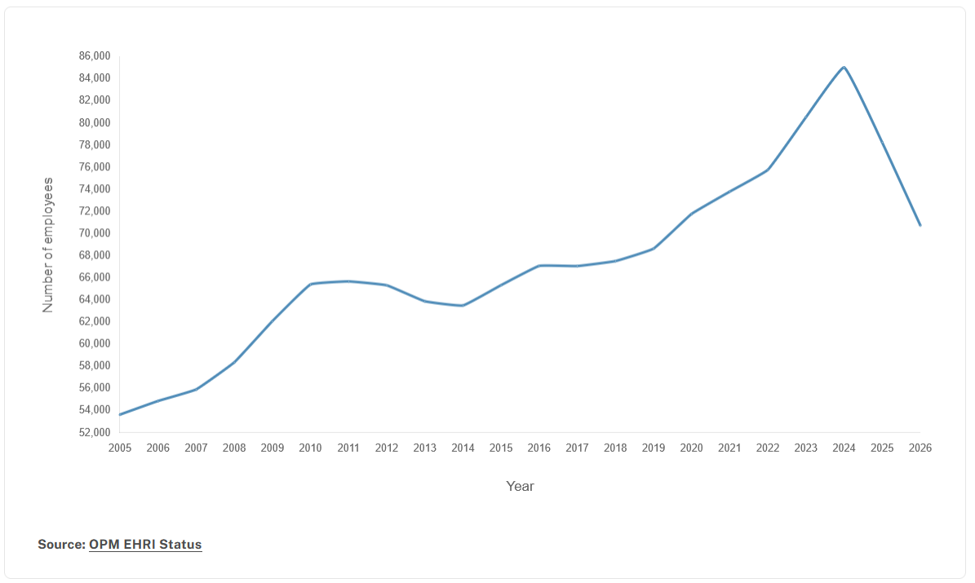
Since President Trump took office last year, nearly 95,000 science employees and over 10,000 PhD scientists have been laid off or left their jobs.
As a former federal scientist and White House Office of Science and Technology Policy official, these losses are deeply personal to me. I’ve seen firsthand how science, data, and evidence help policymakers make informed decisions that improve people’s lives, which is why the erosion of the federal scientific workforce, agencies, and norms are so concerning as we grapple with extreme heat waves and danger season due to climate change, the fastest-growing Ebola outbreak ever recorded, nationwide cyclosporiasis infections from unsafe food and water, and an AI data center boom that is roiling communities across the country, among other things.
And beyond this loss of technical expertise of career federal employees, a less well-known path for science-informed government decision-making has also been in the crosshairs of the Trump administration: federal science advice from experts outside of government, who volunteer their time and expertise to inform government decisions through federal advisory committees.
The importance of federal science advice
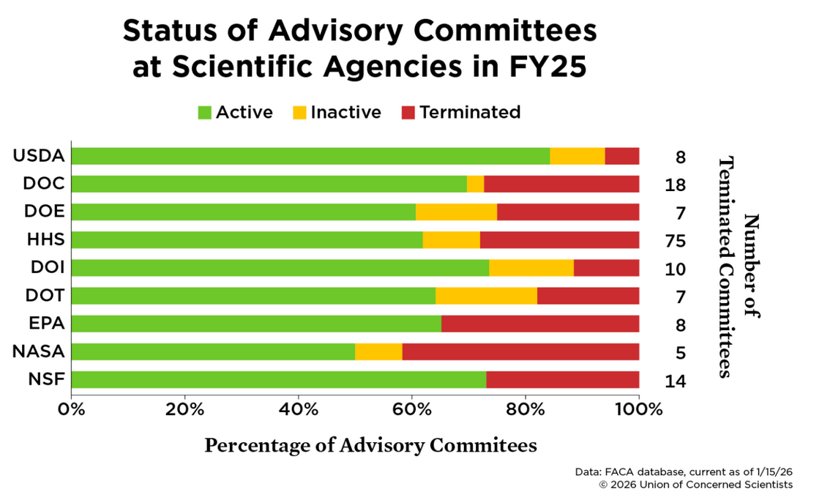
More than 750 Federal Advisory Committees (FACs) currently exist across 51 U.S. government agencies, with 484 of these FACs specifically housed within 9 federal agencies with science-related missions—including the Department of Energy, National Science Foundation, and Department of Health and Human Services.
FACs were created to provide independent, unbiased, and up-to-date technical expertise to inform policy decisions across agencies and issue areas. Historically, they’ve been comprised of the nation’s best independent experts and scientists from academia, state and local government, industry, and nonprofits. Not every government scientist is an expert in every area that they’re expected to inform policies for, so bringing in outside expertise is crucial to their process.
Expert input is essential for science-based responses to complex challenges with global impacts: from the outbreaks of deadly diseases and flood or wildfire disasters to air pollution standards and appropriate pesticide use. And, as we’ve previously written, FACs also bring the public into the work of government, representing a vital form of public participation and civic engagement in a government of, by, and for the people.
How President Trump has kneecapped federal advisory committees and science-based policy
Since 2018, we’ve been tracking how the Trump administration has sidelined science advisory committees and outside scientific expertise in federal policymaking. To hold the administration accountable, we documented stalled and disbanded scientific advisory committees, cancelled meetings, and dismissed experts. Expert input was important then, but it’s arguably even more crucial now with the mass firings of federal scientists and decimation of in-house expertise by DOGE.
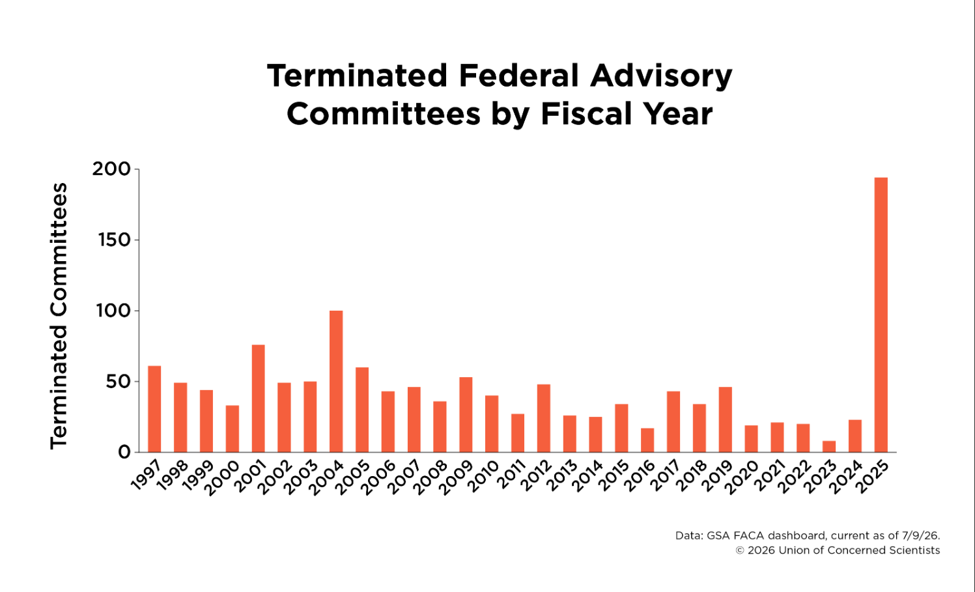
Now, in President Trump’s second administration, the federal science advice infrastructure has been disrupted, which is especially damaging in a corrupted misinformation-rich environment. After a flurry of executive orders, including one dissolving at least one-third of FACs across the government, it was clear that the administration was intent on disrupting federal science advice. In its first six months, the Trump administration terminated or disbanded 27 percent of active science FACs.
One year later, we have a much better picture of the rubble.
As of this writing, the FACA database—a government-run database that hosts information on past and current FACs—has not updated its data for terminated committees beyond 2024. So, we crunched these numbers.
The consequences of even a single disruption to these FACs can be far-reaching. For example:
- In February 2026, term limits expired for the EPA’s Children’s Health Protection Advisory Committee (CHPAC), who advise EPA on wide-ranging environmental issues (e.g., air and water pollution regulations, chemical safety programs, risk assessment policies) that impact children’s health. The EPA solicited nominations in August 2025 and claimed they would fill CHPAC vacancies by March 1, 2026, but as of this writing that has still not happened, and the committee has been inactive since its last meeting in August 2025. CHPAC is tasked with advancing research to implement Trump’s “Make America Healthy Again” agenda, but it’s impossible to see how they will do that when they have failed to hold any meetings, and prioritized industry representatives in their call for member nominations.
- The US Preventive Services Task Force is a volunteer panel at HHS that reviews scientific evidence on tests and medications to help prevent conditions like cancer, diabetes, and HIV. This key health care panel has not met since March 2025 because it has been blocked from doing so four times—leaving important evidence reviews on hold, the public in the dark, and delayed recommendations to guide physicians’ clinical decisions and insurance coverage requirements for millions of Americans. Alarmingly, last year the US Supreme Court ruled that the HHS Administrator can remove members from this panel and override its decisions. This means that political appointees can exert extraordinary influence over an ostensibly independent, evidence-based committee, despite not having the public health expertise on which the panel’s credibility depends—which I assure you HHS Secretary RFK JR. also does not.
- In March 2026, the EPA finally announced its new selection of members, nearly a year after seeking nominations, for the Clean Air Scientific Advisory Committee (CASAC), a powerful panel that provides the agency with crucial scientific expertise to inform air pollution standards to protect public health. It is largely academics who have historically held these seats, but now it’s got the same conflicted and contrarian leader at the helm as during Trump 1.0, in addition to a steel industry official and a member of a fringe Koch-funded climate denial organization that advocates for more carbon dioxide in our atmosphere. Without independent science advice at EPA, we risk having fewer protections from air pollution, water pollution, toxic chemicals and more.
- In April 2026, in another blow to independent science, Trump fired of all 25 members of the National Science Board at NSF, which finances nearly $9 billion in basic science research in labs across the US that powers innovations like our smartphones. As of this writing, there has been no news of the administration reestablishing this board. But perhaps they intend to keep it that way, seeing that they’re trying to politicize all federal research funding through their recently proposed OMB rule.
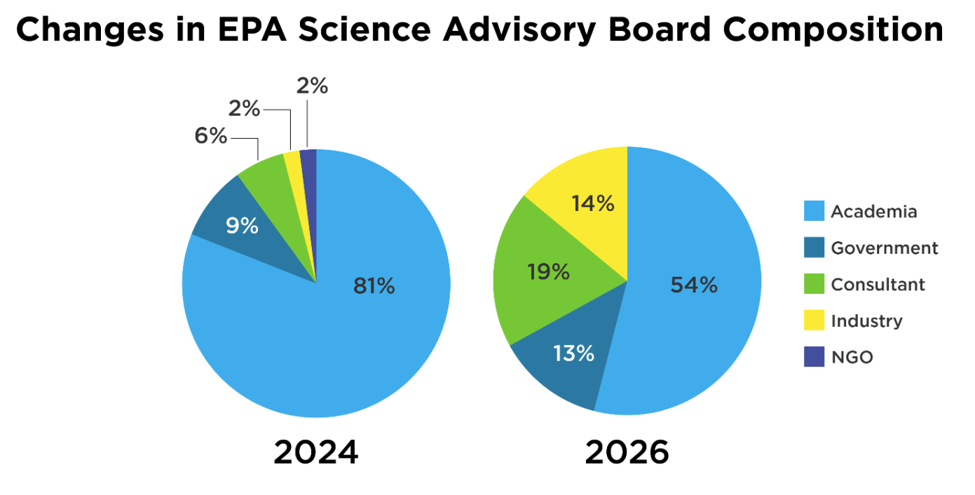
- In April 2026, the EPA finally announced its new selection of Science Advisory Board (SAB) members. The SAB was another casualty of Trump’s war on independent science when he fired the entire board en masse just days before confirming his new EPA administrator. The SAB is responsible for providing independent scientific and technical advice to the EPA to help guide policies, and now it’s been slashed by 11 members (nearly a quarter). Looking at the professional backgrounds of its 2024 vs 2026 membership below, it’s clear this independent scientific body is not only being diminished but also politicized—with several of its members coming from the chemical industry.
How we’re fighting back: building an alliance for independent science
At UCS, we are building an alliance for independent science, a pillar of our Science Rising initiative, in response to Trump’s attacks on science and authoritarian efforts to remove facts, data, and evidence from policymaking.
To counter the Trump administration’s erosion of independent science and build the nation’s capacity to use science for the public good, scientists from several committees that were disbanded or terminated have independently convened to offer policy recommendations on important issues, a powerful and courageous response. Their doing so preserves a vital channel for scientific advice.
In collaboration with the Environmental Protection Network, we are providing strategic guidance, training, and coordination for independent scientists to provide their expertise and recommendations for evidence-based policies, starting with:
- Protecting children’s health: We’re convening former Children’s Health Protection Advisory Committee (CHPAC) members and subject matter experts in plastics, toxics, pesticides, and environmental health to ensure that science can keep our nation’s kids healthy and safe. Operating outside of the government, this group aims to bridge a current oversight gap by operating as an independent, parallel body to preserve scientific rigor and transparency while the formal committee remains inactive. Once it’s active again, the group will conduct oversight of EPA’s activities to ensure that the best available science is used and that the public interest and children’s health remain a priority.
- Protecting clean air: We’re convening a group of former Clean Air Scientific Advisory Committee (CASAC) members and subject matter experts in air quality and public health to monitor and provide rapid response to current industry-friendly EPA actions and inactions that undermine science, public health, or the integrity of the regulatory process. Operating outside of the federal government, this group will develop reports and papers that can inform evidence-based policy for current decisionmakers and—hopefully—a more science-friendly administration in the future.
How you can protect independent science
It’s encouraging and energizing to see such a broad and clear response from the scientific community in defense of independent science. At a time when fear and reluctance to criticize the administration persist from pockets of the scientific community, this kind of solidarity and commitment to independent science are desperately needed for the public good. Current and former science advisors should speak out when they perceive that federal agencies and others in the government are sidelining important scientific work and findings.
We must draw on our expertise, our networks, and our collective resources to adapt our strategies and focus our efforts where they can have the greatest impact. Doing so will require rebuilding the infrastructure, institutions, and communities from outside government to preserve what’s being dismantled within it.
To find out whether there is an FAC in your field of research or interest that has been dismantled, use our guide to the FACA database. To continue the work of dismantled federal FACs, you can use our toolkit for running an independent science advisory committee.
And to help make issues of science and democracy more visible for members of Congress and advocate for hearings on the status of science advisory committees, and ensuring they are carrying out the Federal Advisory Committee Act appropriately, I invite you to join our Science Rising Action Corps.
Action is the antidote to despair, and these are important steps toward reimagining and building a better, stronger federal scientific enterprise.