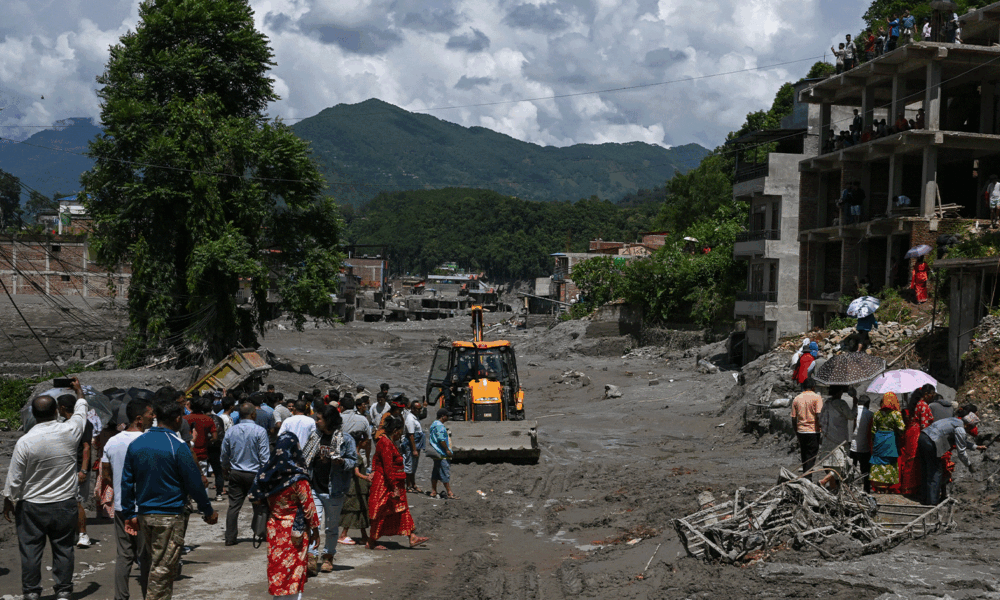

The annual UN climate talks, COP31, will take place in Antalya, Türkiye from November 9-20. People across the world struggling with the ever-worsening toll from climate change—the horrific flood disaster in Nepal is one stark example—need ambitious and fair outcomes from these talks. The latest science on the inevitability that the world will overshoot 1.5°C of global warming also underscores the need for rapid reductions in heat-trapping emissions, alongside ramping up funding for adaptation and climate loss and damage. These talks will also be happening in the context of incredibly fraught geopolitics and close on the heels of consequential elections in the United States, Brazil, and Israel, and massive youth-led protests in several countries.
Will world leaders heed the science and the urgent calls to put people and planet before selfish, myopic political gamesmanship and the corrupt interests of fossil fuel companies? I’ll be on the ground in Türkiye alongside many others—including scientists, civil society organizations, Indigenous and frontline community activists, faith leaders, and youth leaders—to demand that policymakers take action commensurate with the scale and urgency of the climate crisis.
The sobering context for COP31
Two recent UN reports— on Limiting Overshoot of 1.5°C and the annual Emissions Gap report—underscore how far off track the global heat-trapping emissions trajectory is from the guardrails enshrined in the Paris Agreement, the dangers of the current path, and what’s needed to help limit harms.
To limit exceedance of 1.5°C, the emissions gap report says, “global greenhouse gas (GHG) emissions would have to be reduced by 18 per cent by 2030, 45 per cent by 2035 and 69 per cent by 2040, all relative to 2025 levels,” alongside increasing levels of carbon dioxide removal. However, nations’ current commitments would only cut global emissions “by 5-8 per cent by 2030 and 11-15 per cent by 2035, relative to 2025 levels—leaving the world on track to only limit warming this century to 2.6°C.” It’s important to reiterate that those global emission reductions must be achieved in an equitable way, with richer high-emitting nations taking on responsibility for more rapid, steeper cuts and providing climate finance for lower income nations to also sharply reduce their emissions.
The climate impacts of overshooting 1.5°C of global warming, let alone going as catastrophically high as 2.6°C, are truly sobering—including accelerating sea level rise, extreme heat and wildfires, collapse of ecosystems like coral reefs, threats to food and water security and infrastructure, and even irreversible, profound changes to glaciers and permafrost.
The reality is we are already seeing devastating changes today. Research shows that this summer’s brutal heatwaves in Europe killed over 50,000 people, two-thirds of those attributable to fossil fuel-driven climate change. Nepal’s floods triggered by glacier collapse—which bear the clear fingerprints of climate change—has led to a death toll which has crossed 1,500 people, with 5,600 still missing, and a left this low-income nation reeling from over $4.7 billion dollars in damage.
Pre-COP stage-setting
This COP is unusual in that, for the first time, there will be two countries sharing leadership roles, Türkiye and Australia—a compromise solution reached in Brazil at COP30 after a protracted stalemate last year. The COP31 President is Murat Kurum, Türkiye’s minister of environment, urban planning and climate change. Chris Bowen, Minister for Climate Change and Energy for Australia, has been appointed as COP31 President of Negotiations.
The Pacific pre-COP meeting held in Fiji in early October—which was far too sparsely attended—highlighted urgent priorities for the region, long champions for the 1.5°C goal, high ambition and equity in the climate negotiations. Nations endorsed the Taku Pakasoa Declaration, a Tuvaluan phrase connoting strength in unity and collective action. The powerful declaration recognizes the leadership of youth, Indigenous people, and local communities, as well as the Pacific Island nations which requested the historic International Court of Justice Advisory Opinion clarifying states’ legal obligations to address climate change. It also calls attention to the imperative of using the best available science to inform climate action, the need to enhance climate finance for lower income nations, and elevating the importance of the ocean-climate nexus.
As Filimoni Vosarogo, the Fiji Minister for Lands and Mineral Resources noted: “The ocean has absorbed around a quarter of the carbon dioxide that we emit as humans and more than 90% of the excess heat that we have trapped. It is the planet’s climate regulator and the largest carbon sink active, and the reason the world is not already far warmer than it is. And it’s paying for this service with its health.”
For more on the ocean-climate nexus, please read this blogpost from my colleague Erika Spanger.
Key Issues for COP31 Negotiations
Here are some of the crucial issues that will determine success (or lack thereof) at COP31:
- Can a global electrification target help advance a transition away from fossil fuels to renewable energy? At the June climate talks in Bonn, the COP31 Presidency announced a new “35% by 2035” global electrification target—to raise the share of final energy demand met by electricity to 35% by 2035 from just over 20% today—as a centerpiece of its Action Agenda for COP. A subsequent report from the IEA shows how this can be achieved cost-effectively using technologies available today. To truly advance climate progress and cut global heat-trapping emissions, electrification of energy use across sectors including transport, industry and buildings must be accompanied by a just transition away from fossil fuels to renewable energy as well as enhanced energy efficiency. The human and economic toll from the fossil fuel energy crisis triggered by the US’s illegal war against Iran underscores, yet again, why a transition to clean energy is the best path forward. While renewable electricity—especially cheap, plentiful solar power—is booming globally, it’s not yet displacing fossil fuels fast enough. Insights from the Santa Marta conference on a Just Transition Away from Fossil Fuels hosted by Colombia and the Netherlands, with a second one hosted by Tuvalu and Ireland now in the works, can help drive momentum alongside and within the COP negotiations. The deep-pocketed fossil fuel industry and its allies have long worked to obstruct progress at the UN climate talks. World leaders must stand up to those destructive tactics, hold fossil fuel companies accountable and chart a rapid path toward a fast, fair phaseout of fossil fuels.
- Will leaders prioritize adaptation and loss and damage? Adaptation and loss and damage do not get nearly enough attention at the climate talks, leading to a continued shortfall in commitments and funding for these priorities from richer nations. As global heat trapping emissions continue to rise, already putting the world on a trajectory to soon exceed 1.5°C of global warming, many communities are struggling to cope with extreme climate impacts, often beyond their ability to adapt. This year’s deadly heatwaves in Europe, Asia and Africa; intensifying Pacific typhoons and hurricanes; catastrophic wildfires in Canada, the US, Spain and Portugal; and the terrible floods and mudslides in Nepal triggered by melting Himalayan glaciers are just the latest reminder that burning fossil fuels has dangerously altered the climate regime. It’s not enough to just react after disasters hit; we have to ramp up resilience proactively to protect people ahead of time. The UN Adaptation Gap reports repeatedly point out the massive gap in funding required by lower income nations, in the absence of which people are losing their lives and livelihoods and entire economies are being battered by climate disasters. Adaptation finance must be at least tripled by 2035, as already agreed, and concrete outcomes are needed on the Global Goal on Adaptation. Nations—especially high-emitting, rich nations—must do their utmost to cut heat-trapping emissions and get to net negative emissions quickly to limit climate change. And they must provide funding for people on the frontlines of the climate crisis who desperately need investments in resilience and measures to address the loss and damage they’re already facing. The Fund for Responding to Loss and Damage (FFRLD) has just agreed to “set aside” $21.6 million dollars in response to Nepal’s urgent ask for support after its deadly floods, at a first-ever Extraordinary meeting of the FFRLD Board on Oct 22. Nepal and many more low-income countries reeling from devastating climate impacts caused by richer countries’ emissions deserve justice on a much larger, more meaningful scale. It’s absolutely shameful how paltry the amounts are that richer nations have thus far committed to the FFRLD.
- Will climate negotiations be guided by the best available science from the IPCC? Recent climate meetings have seen a highly concerning trend of attacks on the inclusion of references to the best available science from the IPCC in negotiating texts. Added to this, the suspension of the recent IPCC plenary meeting because of a continued lack of agreement between countries on the timeline for producing the IPCC’s seventh assessment cycle of reports (AR7) ahead of the conclusion of the second global stocktake under the Paris Agreement in 2028 is extremely worrying. Science and equity should never be pitted against each other. Using the best available science to guide and inform the climate negotiations, emissions reduction goals, adaptation investments and measures to address loss and damage is vital to protecting people and ecosystems. “For countries on the frontlines of climate change, timely science is not a matter of convenience. It is essential for protecting lives, livelihoods, and our futures. We cannot afford a process in which the best available science arrives too late to inform decisions that will shape our survival,” Ambassador Adao Soares Barbosa, Chair of the Least Developed Countries Group on Climate Change powerfully said in a recent statement. Crucially, world leaders must commit to funding mitigation, adaptation and loss and damage in equitable ways so that poorer nations are not unfairly burdened with the costs of responding to climate change caused primarily by rich nations. Equity is a core principle guiding the UN Framework Convention on Climate Change (UNFCCC) and should not be treated as an afterthought or optional. Without that, we greatly increase the risks of falling short of necessary climate goals, putting more people and more critical ecosystems in danger.
- Will richer countries address their grossly insufficient climate finance commitments? Year after year, richer nations continue to renege on their climate finance commitments, even as they deepen the climate crisis by remaining tethered to polluting fossil fuels. This injustice is untenable and is directly contributing to a breakdown in trust in the UN climate negotiations. Lower income nations struggling to overcome poverty and reach basic development milestones are being set back repeatedly by climate-fueled disasters, wars, and unsustainable debt. Added to that, the unfolding Super El Niño, coming on top of fossil fuel-driven climate change—threatens to push tens of millions more into acute hunger. Global North countries must prioritize climate finance—including tripling adaptation finance by 2035—on par with actions they must take to phase out fossil fuels, otherwise the world will not meet climate goals and the inequities of that failure will mount.
- Can leaders find ways to drive forward climate ambition in a new world order? Current geopolitics, including the destructive actions of the Trump administration, are scrambling the world order in unpredictable ways. One certainty is that addressing major global challenges—including climate change—requires global cooperation and cannot be solved through unilateral actions by any one nation. And it’s not enough for global climate agreements to just endure; world leaders must actively recommit to meeting their goals in a just way. UN Secretary-General António Guterres, an extraordinary climate champion, will soon come to the end of his term and the new UNSG will face a formidable task on multiple fronts, including urging greater ambition to meet climate goals. COP32 in Addis Ababa, Ethiopia, next year, and the 2028 conclusion of the next global stocktake under the Paris Agreement, will be key moments for measuring progress coming out of Türkiye.
“For countries on the frontlines of climate change, timely science is not a matter of convenience. It is essential for protecting lives, livelihoods, and our futures. We cannot afford a process in which the best available science arrives too late to inform decisions that will shape our survival.”
Ambassador Adao Soares Barbosa, Chair of the Least Developed Countries Group on Climate Change
Renewed clarity, determination and resolve
The latest science on fossil fuel-driven climate change is truly sobering, as are the dire impacts already devastating communities around the world. The gross injustice of climate change is also mounting—for billions of people today who are suffering despite contributing the least to the problem, and for young people and generations to come who are literally seeing their futures greatly diminished because of choices being made today by the rich and powerful.
The United States, the world’s biggest historical emitter, has played an especially egregious role in stepping away from the UNFCCC and the Paris Agreement, with the Trump administration taking a wrecking ball to federal clean energy and climate policies. The 2026 UNEP emissions gap report notes that in 2025 “emissions growth slowed down in the G20, with the United States of America being the major exception.”
It bears repeating that we already have most of the core climate solutions we need today, and those solutions can help advance public health and economic prosperity too. Richer nations also have the ability to raise the funding needed to scale up climate solutions globally—they are just choosing to spend it on things that are directly contrary to the public good (such as endless wars) or on outright giveaways to fossil fuel industry and corporate billionaires while driving up costs to everyone else.
As scientists and climate justice advocates, these times can feel dark and daunting. In many ways, the climate future we feared is now here—deadly and costly fossil-fueled disasters mounting, oceans boiling, an accelerating pace of warming, and the profound injustice of the worst losses inflicted on those who are least responsible for climate change. Wars, lack of care for our shared humanity, and the erosion of multilateral institutions are taking the world in the opposite direction from acting in the collective good.
Yet the solutions we have been fighting for are (still) exactly what this moment calls for, which brings renewed clarity, determination and resolve. Whether we are trying to address inequality and affordability concerns, pollution and public health challenges, the energy poverty gap or food insecurity, it’s clear that just climate and clean energy solutions are crucial to improving human welfare and healing the planet.
Wherever you are engaged in this transformative fight for climate justice—from your hometown to world capitals to international venues like COP31—this is a fight we must win, for people across the world today and for the sake of generations to come. We are on the right side of history as we take on intransigent politicians and fossil fuel villains to save a livable future.