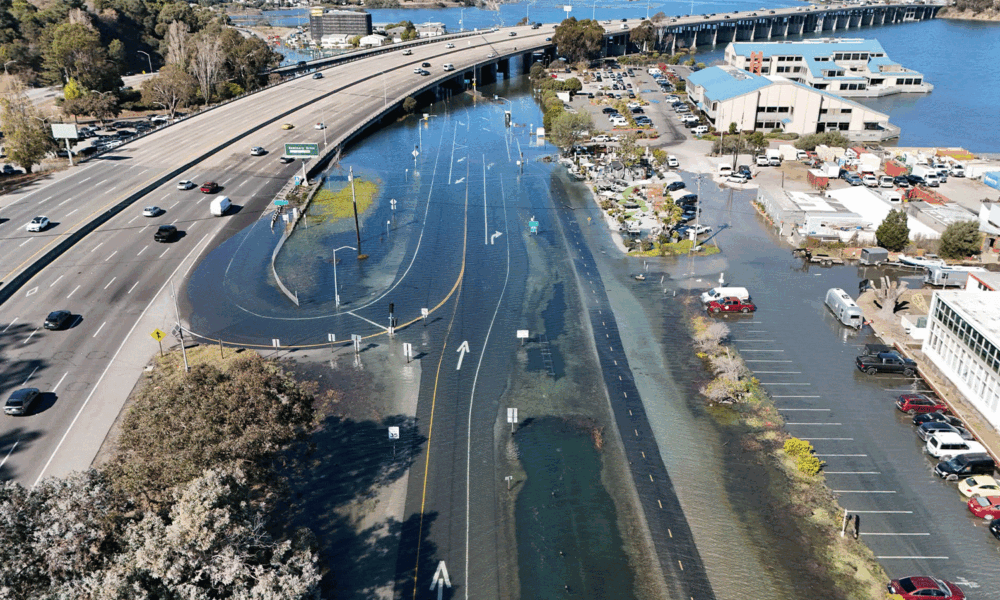

Even if you don’t live in California, the large waves raging at Southern California’s coast probably caught your attention. Many have likely seen the reports showing the ocean bombarding coastal homes in Long Beach with some homes looking like they’re about to fall into the ocean at any minute, or people kayaking in flooded roadways. What’s so different about this year and what exactly is going on in California? What we’re witnessing is the state being hit with the intense effects of a super El Niño that´s compounding the impacts of climate change. And although California is aggressively preparing for the coastal risks from accelerating sea level rise and El Niño impacts that will last into the new year, the state will need support from FEMA now and in the future. Meanwhile, FEMA has begun to distance itself from its mission of providing disaster assistance at the worst possible time.
Coastal impacts—What’s El Niño got to do with it?
Fossil fuel-driven climate change and El Niño both have their fingerprint on what we’re seeing. Warmer ocean temperatures in the eastern Pacific Ocean from the super El Niño and climate change have created a perfect storm: a record hurricane season for the Eastern Pacific, higher sea levels, increased wave heights, heavier rainfall and extensive coastal erosion. The combination of sea level rise, ocean heat, king tides, Kelvin waves and peak tidal cycles means wave heights are higher, can reach further inland, and are more dangerous.
While El Niño events are part of a natural cycle in our climate system, climate change is helping to load the dice to produce more intense El Niños, my colleague Dr. Marc Alessi explains in a recent blog. We’re already witnessing the strongest El Niño on record. A large part has to do with the fact that ocean surface temperatures have reached a record high thanks to fossil fueled-climate change.
The southern California coast is not only dealing with sea level rise from fossil fuel-driven climate change and the super El Niño but has also seen impacts from multiple tropical systems intensifying in the very warm Pacific Ocean, including the remnants of Hurricane Marie in September and Tropical Storm Rachel in October.
Southern California has been hit particularly hard by coastal flooding. Earlier this month, Orange County declared a state of emergency, as did Laguna Beach, Long Beach, Dana Point and San Clemente. Some of these towns are dealing with multiple emergencies like San Clemente, which recently was working to put out the Norte fire.
Dana beach is one example where the town will take advantage of an emergency permit from California’s coastal commission to fast track a rock filled berm to temporarily protect more than a dozen properties, to the residents’ consternation—they want a permanent solution to protect their homes. Typically, California’s Coastal Development Permit requires a more in-depth application that shows compliance with coastal rules and public notices.
What is California doing to prepare for El Niño?
California has been proactive in its response to projected El Niño impacts. In September, Governor Gavin Newsom declared a state of emergency (read the declaration here) to help prepare and protect vulnerable communities and infrastructure from flooding, landslides and other risks associated with the developing El Niño.
California Office of Emergency Services (CalOES) is working with local agencies and is looking at preparing for more coastal erosion, riverine flooding, landslides, debris flows and power outages. They’re also looking at areas affected by wildfires, particularly newer burn scars because that ground will not soak up water as well, which can increase the risk of land- and mudslides (such as in recently burned areas in San Bernadino, Los Angeles and Northern California rural communities).
California is also coordinating messaging across state agencies and partners and communicating guidance such as the need for communities to understand their local risk, sign-up for local public alerts and have an evacuation plan so each person knows where to go and knows how to stay connected with their family and has supplies for power outages (such as necessary medications, back-up power, or pet supplies).
While California has invested in the latest science and tools and tends to be well prepared to respond to disasters, it still faces the challenge of having many people, homes, critical infrastructure and precious ecosystems in harm’s way. As climate change worsens and disasters mount, it needs resources to protect and help communities recover from disasters, as well as rebuild and make infrastructure more resilient. And California is not so different from any other state when it comes to major or catastrophic disasters. States and Tribal nations need federal support from FEMA and will request a disaster declaration for federal disaster assistance when the scale of the disaster exceeds their reserves and capabilities.
Under usual circumstances, for help with basic infrastructure recovery, states will request resources from FEMA’s Public Assistance program to support clearing debris from roads, covering household rooftops with tarps, or building back critical infrastructure like water or electric utilities.
States may also apply for resources under the Individual Assistance program to provide communities with a range of support including temporary housing. But under the Trump administration, FEMA has been completely politicized and is increasingly stepping way from its core functions and responsibilities even as its staff has been drastically reduced. All of this is cruelly putting people in more danger and leaving them feeling abandoned after disasters.
Longer-term coastal adaptation
Flooding and erosion are not new threats to the California coast, and sea level rise due to climate change will require long term adaptation. My colleague Dr. Ángel S. Fernández-Bou contributed to California’s Fifth Climate Change Assessment that was recently released, and he wrote about the striking reality check it provides for California’s future. One in five Californians—about 7 million people—live in areas at risk of flooding, according to the report. Farmworkers, Indigenous communities and communities of color, rural communities, renters, people experiencing homelessness, and low-income individuals and families face the most exposure to flooding and have the fewest resources to recover, the assessment found.
As CalOES has been planning to respond to the disasters right in front of them, California’s Coastal Commission has been preparing for these coastal risks, issuing sea level rise policy guidance in 2024 that provides the best available science on sea level rise and guidelines for local governments to develop sea level rise adaptation plans and better integrate environmental justice. The guidance provides specific adaptation strategies for seven different coastal sectors, all of which are applicable to other coastal areas.
So what does coastal adaptation look like? There are a range of measures traditionally organized under three categories: protect, accommodate, and relocate. Protecting our coasts against ocean-driven change, whether storm damage, erosion from waves, and, increasingly, tidal flooding, has widely been a first-order response. While historically it relied on hard infrastructure, like sea walls, protection also now relies on nature-based solutions.
Accommodating sea level rise can be accomplished by elevating or retrofitting structures and making space in communities for water to go. Retreat, unfortunately, has often occurred reactively, post disaster, and has caused harm to social capital and disruptions to community cohesion particularly disadvantaged and lower-income communities. Carefully planned relocation and strategic coastal retreat will become increasingly necessary as seas rise and coastal disruption mounts and will need to be approached in ways that minimize these harms.
The Fifth National Climate Assessment speaks to how we often see incremental adaptation or minor shifts that primarily preserve the status quo and notes that this leaves us at unacceptable risk. We also must work towards transformative adaptation which can mean major shifts in behavior and technology and landscape-scale solutions. The best available science will be critical to supporting which adaptation measures make the most sense and must be done with community involvement to ensure just transitions. Likewise, it’s important to avoid maladaptive measures that contribute to more risky development, provide very short-term relief while increasing risks over time, or privilege wealthier communities while leaving lower income communities exposed.
An iconic coastal adaptation project is Surfer’s Point in Ventura, which represents a hybrid approach including retreat (moving back the parking lot and bike path) and protection (beach and dune system that incorporated an engineered cobble berm). While it took decades to finish and needed multiple champions and funding sources, the good news is, it looks to have survived the September storms. Let’s hope Surfer’s Point will continue to be resilient to Super El Niño’s impacts into the new year and continue to serve as a model for effective coastal adaptation.
Local governments must also plan for adaptation. In 2023, California passed SB 272 requiring that local governments plan for sea level rise and develop adaptation plans by 2034. These plans must include the best available science, vulnerability assessments, adaptation strategies and project recommendations, among other elements.
The good news is, California is investing in and mandating resilience even in the absence of federal leadership and resources. In addition to the climate science and adaptation strategy guidance, California has grant funding available targeted for specific risk.
In 2024, California passed proposition 4, a milestone funding mechanism establishing a $10 billion climate bond with requirements for at least 40 percent of that funding to be directed to disadvantaged or vulnerable communities and 10 percent of that to severely disadvantaged communities. Of these funds, $1.2 billion is targeted for coastal flood resilience. This targeted funding is welcome news to historically disinvested in California communities living in close proximity to hazardous facility sites and are at risk of flooding.
What does California tell us about future climate resilience needs?
This snapshot of California’s coastal resilience illustrates that while California is a big state with a long coast (2nd longest in the lower 48 states) and many towns along the way to support, we can learn from how the state is responding to El Niño and the risks that come from fossil-fueled climate change. These lessons can be shared and incorporated across all levels of government.
Key lessons include:
- Leadership matters;
- Releasing an early emergency declaration helps on many fronts including (hopefully) advancing federal resources and uniting state communication and resources;
- Investing in climate science is essential, as is guidance on adaptation strategies;
- Adaptation takes time, partners and funding: start now; and
- Legislation that provides both incentives (e.g. funding) and guardrails (e.g. regulations) is critical.
While we reflect on these lessons, we must advance a broader conversation with communities across the nation and demand action from the next Congress for a robust package of climate resilience provisions. And we must remember that even though not every state has the resources California does, federal support is crucial for all states, especially those lower resourced states.
It’s been five years since the Infrastructure Investment and Jobs Act (IIJA) was signed into law, and it’s been four years since what was considered the major climate bill—the Inflation Reduction Act (IRA)—was signed into law. While IIJA had a considerable amount of climate resilient investments spread across many federal agencies, the IRA bill was primarily focused on emissions reductions. Despite the many climate change mitigation projects these bills funded, measures to throttle clean energy and transportation in favor of fossil fuel expansion have contributed to record-breaking global average temperatures for three years in a row. As my colleague Dr. Rachel Cleetus wrote “the climate future we feared is here.”
We don’t have time to wait. Whether it’s chronic tidal flooding, El Niños, hurricanes, flooding from extreme rainfall, wildfires, extreme heat, or drought, communities are being impacted repeatedly, and we need Congress to be ready to act.