
Over the last year and a half, the Trump administration has recklessly dismantled the democratic institutions that keep us safe, including the systems that rely on the best available science to inform government decision-making. This campaign has resulted in more than 560 attacks on science to date. Among the federal agencies hit hardest by these attacks is the U.S. Environmental Protection Agency (EPA).
In March 2025, the agency announced that it planned to eliminate its Office of Research and Development (ORD)—the EPA’s hub of independent scientific research. As I highlighted last year, ORD’s closure constitutes a huge loss for independent science at EPA. ORD was intentionally created as a standalone office outside of EPA’s policy offices (like the Office of Air and Radiation and the Office of Water, among others), so that scientific research could be conducted without undue influence from political appointees who might have conflicts of interest. Several of the major environmental laws that EPA is tasked with enforcing, like the Clean Air Act and Toxic Substances Control Act, explicitly require the agency to rely on scientific evidence in decisionmaking. ORD exists for exactly that reason—so that EPA decisions are informed by the best available scientific evidence, not by ideology or the demands of politically-powerful interests.
EPA replaced the independent ORD with a new Office of Applied Science and Environmental Solutions (OASES), which sits within the EPA’s Office of the Administrator. That puts science under direct control of political appointees: a recent memo sent to OASES employees outlines the new project approval process, emphasizing that political appointees must approve new research projects.
After a year of continuously chipping away at EPA’s capacity to regulate pollution, enforce regulations, conduct rigorous scientific research, and protect public health, the Trump administration is undeniably increasing the risks Americans face from toxic chemicals.
IRIS, the small ORD program that saved lives
EPA’s Integrated Risk Information System, or IRIS, was a program that sat within ORD’s Center for Public Health and Environmental Assessment. For decades, the scientists in IRIS worked to understand and explain the health risks associated with exposure to chemicals. This research informs pollution regulations at the federal, state, and local level. As the EPA’s own website states, “The placement of the IRIS Program in ORD is intentional. It ensures that IRIS can develop impartial toxicity information independent of its use by EPA’s program and regional offices to set national standards and clean up hazardous sites.” IRIS’ toxicological assessments are considered best practice, undergoing a rigorous review process to evaluate the degree to which chemicals like formaldehyde or ethylene oxide are associated with certain health effects, including cancer.
This effort to target IRIS didn’t just emerge—the Trump administration is implementing a long-running plan. The chemical industry sought to kill the IRIS program for years, propping up misleading and false excuses to undermine a program whose work might challenge their interests. Project 2025, the right-wing policy roadmap that has guided the second Trump administration, advocates for ending the IRIS program, and members of Congress have introduced legislation that would ban EPA from relying on the 500+ assessments completed by IRIS in agency rulemaking.
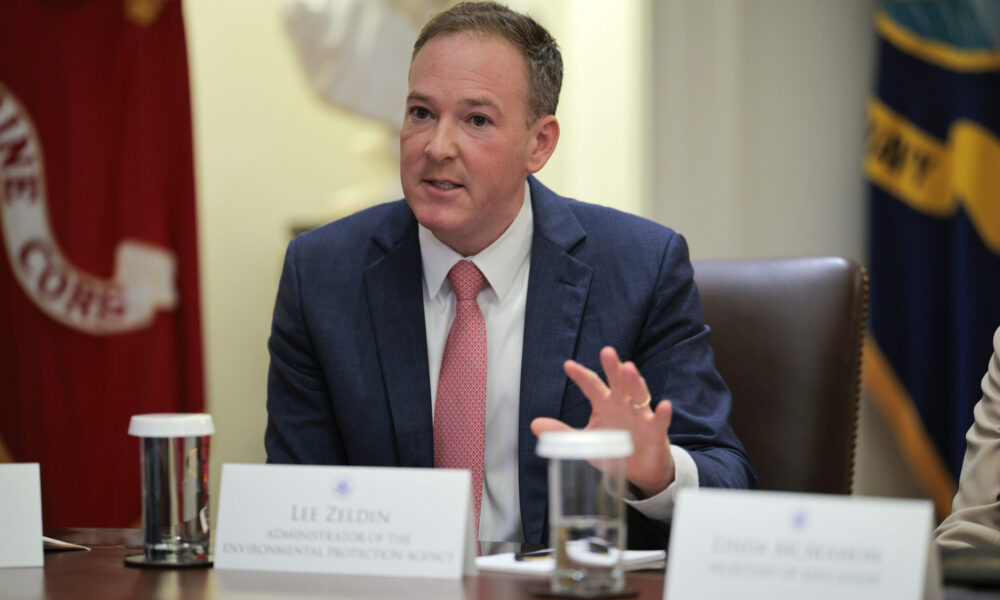
Until President Trump came into office, EPA vehemently defended its IRIS assessments, and even the National Academies of Sciences, Engineering, and Medicine (NASEM) have affirmed the use of IRIS values. Now, with President Trump’s appointee Lee Zeldin in charge, the EPA has completely changed course.
A recent internal memo obtained by ProPublica shows David Fotouhi, President Trump’s deputy administrator of the EPA, directing all agency offices to review any IRIS assessments used in past agency decisionmaking and discouraging their use in future regulation.
Ethylene oxide, the cancer-causing gas EPA can’t seem to quit
In the memo, Fotouhi specifically calls out ethylene oxide, an invisible gas used for medical sterilization and produced in chemical manufacturing that IRIS determined was a carcinogen in 2016. Under the Biden administration, EPA undertook long overdue actions to strengthen regulations for several types of industrial facilities that emit ethylene oxide, including medical sterilizers. These actions would have significantly reduced cancer risks for the millions of people in the U.S. and Puerto Rico living or working near ethylene oxide-emitting facilities. But when President Trump once again took office, the agency reversed course and has rolled back many of the regulations limiting emissions of toxic air pollutants like ethylene oxide.
IRIS’ 2016 assessment found that long-term inhalation of ethylene oxide can cause white blood cell and breast cancers, and that the risks are especially pronounced for children. EPA was able to significantly strengthen controls for ethylene oxide-emitting facilities because of IRIS’ scientific conclusions (an assessment that took a decade to complete and included rigorous independent review). Now Fotouhi—who previously represented a medical sterilization company and other polluters as an attorney—is sowing doubt in the IRIS ethylene oxide assessment, echoing unsubstantiated claims made by the Texas Commission on Environmental Quality and American Chemistry Council for years. Their claims are also counter to conclusions by a NASEM independent committee in 2025, which supported EPA’s methodology for developing IRIS assessments. The agency even went so far as removing information about the health risks of ethylene oxide from its website, depriving the public of crucial information about the harms of exposure. We are witnessing in real-time EPA cutting the science out of decisionmaking to further a profit-motivated deregulatory agenda.
In EPA’s recent proposed rollback of ethylene oxide emissions standards for medical sterilizers—which will expose tens of thousands of people to “unacceptable” cancer risk levels—the agency states that, “it would not be appropriate to rely on the 2016 EtO IRIS value in setting standards,” urging the public to submit “alternative values […] that would be more appropriate…” In the proposal, EPA claims that two new studies introduce uncertainty into the 2016 IRIS value, but if you read the studies, they do not address health endpoints that can be compared to the IRIS assessment. In fact, one of the studies supports the 2016 value. Furthermore, a recent draft cancer risk assessment published by California’s Office of Environmental Health Hazard Assessment includes a literature review from the last decade, arriving at the same conclusions as the 2016 IRIS assessment. You can read more about EPA’s unsupported claims about the 2016 ethylene oxide IRIS assessment in a comment I contributed to and led by our partners at Earthjustice, and our broader comments on the rule here. The science is clear—the Trump administration just doesn’t want to hear it.
Where does that leave us? EPA is giving polluters a free pass, unlawfully eliminating regulations, abandoning the scientific findings that enabled regulation of global warming emissions, no longer considering the benefits of human lives saved by regulation, and now ripping out the scientific foundation that keeps these rules effective. Ultimately, these actions betray the basic job of the EPA. In the Trump administration, EPA leaders are allowing corporations and polluters to evade rules based on science, and secure policies that are convenient for their own profits, at the expense of our health. And in the end, the harm will be foisted upon the American public.